
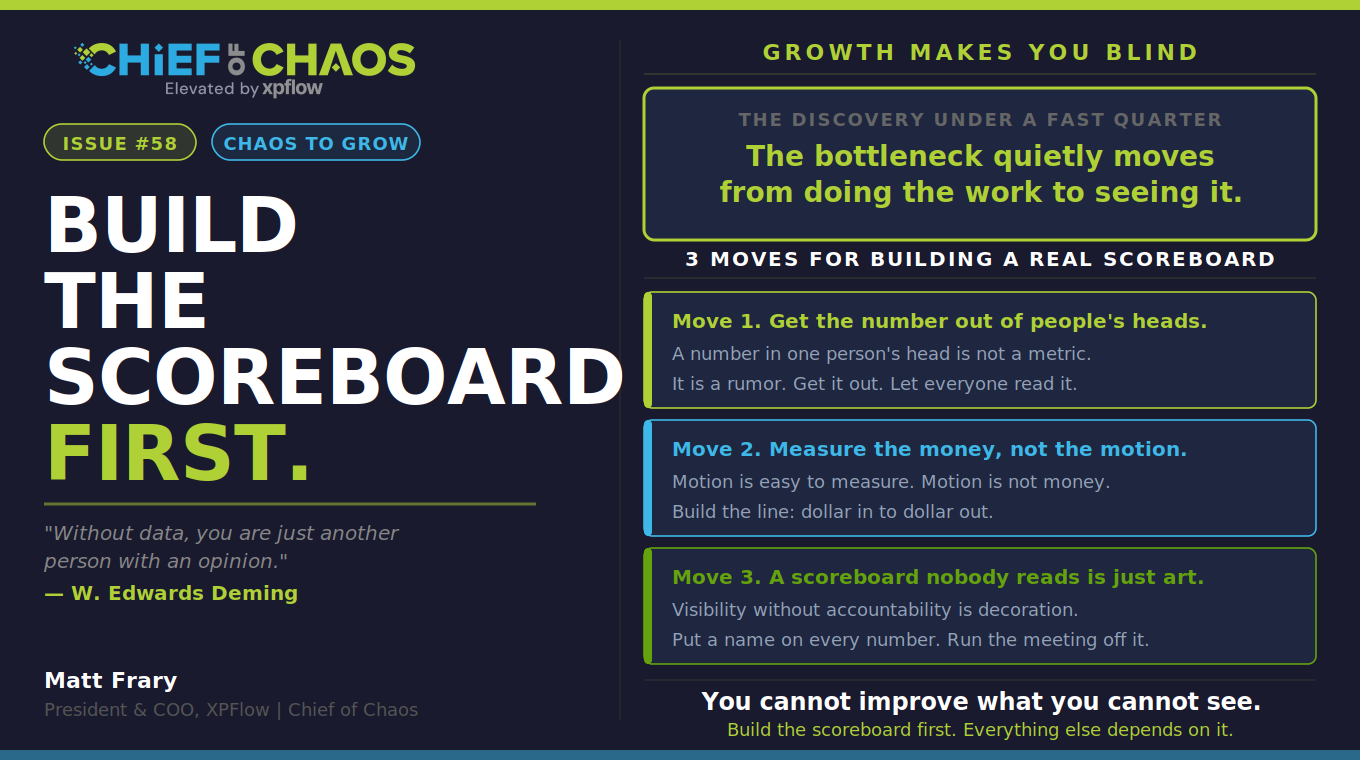
“Without data, you are just another person with an opinion.” W. Edwards Deming
I spent last week in a lot of rooms from Dallas to Denver, and almost every one of them was about the same thing.
On the surface they looked like different meetings. Pipeline. Paid media. Sales comp. A funnel review. A standup. Different people, different problems, different parts of the business. But underneath, they were all one meeting, asked over and over in slightly different words: what is actually happening here, and can we all see it?
That is not the meeting you expect to be having when things are going well. We are growing fast. New office, more people, more deals in motion than at any point in this company’s life. And the thing that kept tripping us up was not the work. It was our ability to see the work. The number that mattered was always somewhere, just not somewhere everyone could look at it at the same time.
This issue is about the unglamorous discovery underneath a fast quarter. As you scale, the bottleneck quietly moves from doing the work to seeing it. And the fix is not another hire or another push. It is a scoreboard.
What You’ll Get in This Issue
Why the moment a company starts to grow is the exact moment it goes blind, and why nobody warns you about it. Three moves for building a scoreboard that actually changes what your team does, instead of one more dashboard nobody opens. And the thing a visible number buys you that has nothing to do with control and everything to do with honesty.
Part One: Growth Makes You Blind
When it is just you and a couple of people, you are the scoreboard.
You know every deal because you are on every call. You know what the ads are doing because you are the one watching them. You know which lead went cold because you are the one who let it go cold. The whole business fits in your head, and your head is faster than any dashboard, so you never build one. You do not need to. You are the single source of truth, and you are standing right there.
Then you grow, and the thing that made you fast becomes the thing that makes you blind. Now there are deals you are not on. Spend you did not approve personally. Leads moving through hands that are not yours. The business stops fitting in one head, and the instinct that served you for years, the one that says “I already know what is going on,” quietly becomes the most dangerous assumption in the building.
That was the real lesson of this week. Not that anything was broken. That we had outgrown the version of visibility that used to be free. A pipeline that lives in one person’s memory is not a pipeline, it is a rumor. Ad spend that nobody can tie to a sale is not a strategy, it is a hope. We had real money going out and real activity happening, and the honest answer to “is it working” was too often “it depends who you ask.” That is the sound a company makes right before it starts flying on feel.
So we did the boring, foundational thing. We started building the scoreboard we should have built a size ago. Here is what that actually takes.
Part Two: The Playbook
Three moves for building a scoreboard that runs your business instead of decorating it. None of them are about better software. They are about discipline.
Move 1: Get the Number Out of People’s Heads.
The first job is not analysis. It is extraction.
The most important numbers in a growing company are almost never missing. They are just trapped. The real pipeline is in the head of the person who runs sales. The truth about the ad spend is in the head of the person buying media. Everyone is holding a piece of the score, and nobody is holding the whole thing. So every status meeting becomes an archaeology dig, and every forecast is really just a confident person’s guess wearing a number.
A scoreboard ends that. One number, one place, defined one way, that everyone reads the same. Not your version and their version. The version. The work is not glamorous. It is taking the deals out of memory and putting them in the system, tying the spend to the outcome, agreeing on what each stage even means. But until that number lives somewhere outside a single skull, you do not have a metric. You have folklore.
→ A number that lives in one person’s head is not a metric, it is a rumor. Get it out, write it down, and let everyone read the same score.
Move 2: Measure the Money, Not the Motion.
Here is the trap I watched us nearly fall into, and it is the one almost every team falls into.
When you finally start measuring, the easiest things to measure are the busy things. Emails sent. Calls made. Clicks. Impressions. Motion. It feels like progress because the charts go up and to the right, and motion is genuinely satisfying to watch. But motion is not money. You can have a gorgeous dashboard full of rising lines and still not be able to answer the only question that pays the bills: for every dollar we put in at the top, how many came out the bottom, and how do we know?
That was the question we kept circling. We could see what we spent. We could see leads. What we could not cleanly see was the line connecting the dollar that went into an ad to the dollar that came back as a sale. And without that line, every other number is just decoration. So the move is to build the boring connective tissue first. Spend to lead. Lead to call. Call to close. Close to revenue. Measure the chain that ends in money, not the activity that feels like work.
→ Motion is easy to measure and motion is not money. Build the one line that connects a dollar in to a dollar out, then measure that.
Move 3: A Scoreboard Nobody Reads Is Just Art.
We have built dashboards before that nobody looked at twice. They were beautiful. They were useless. And the reason is simple: a number only matters if it changes what somebody does on Monday.
Visibility without accountability is just expensive art. The dashboard does nothing until it has a name next to it, until one specific person owns that number and answers for it in the room. The point of the scoreboard is not to admire it. The point is that the weekly meeting runs on it, that the conversation starts from the number instead of from opinions, and that when the number is bad, everyone is looking at the same bad number instead of debating whose memory is right. A score with no audience and no owner is decoration. A score the team runs on is a nervous system.
So do not stop at building it. Wire it into how the team actually works. Put a name on every line. Open the meeting with the board. Make it the thing nobody can look away from. That is the difference between a report and a habit.
→ Visibility without accountability is decoration. Put a name on every number and make the team run the meeting off the board.
Part Three: What a Visible Number Actually Buys You
Here is the payoff that surprised me, because I went into the week thinking a scoreboard was about control. It is not. It is about honesty.
When the number is hidden, every hard conversation turns political. Why is the pipeline soft. Whose lead went cold. Is the spend working. With no shared truth in the room, those questions become about people, about blame, about whose story is more convincing. The most persuasive person wins the meeting, and the most persuasive person is very often wrong. You end up managing opinions instead of reality, and you cannot feel it happening because everyone is so reasonable about it.
A visible number kills all of that in one move. When the whole team can see the same score, the argument stops being about who is right and starts being about what we do next. Nobody has to be attacked, because nobody has to be the source of truth. The board is. That is the quiet gift of measurement that nobody tells you about: it does not just tell you how you are doing, it takes the politics out of the room and hands everyone their dignity back, because the number is doing the hard talking instead of a person. The scoreboard is the cheapest culture tool you will ever build.
→ A hidden number makes every hard talk political. A visible one ends the debate, because the score does the hard talking instead of a person.
Your Weekly Chaos Challenge
Pick the one number that most decides whether you win this quarter. Just one. Revenue, pipeline, cash, conversions, whatever it actually is for you.
Now ask the uncomfortable question. Can everyone on your team see that number right now, today, without coming to ask you? If the honest answer is no, you just found your week. You do not need a better tool. You need to take that one number out of your own head and put it somewhere your whole team can see it without permission.
That is the whole exercise. Not a dashboard project. One number, made visible, made owned.
→ Take the single number your quarter depends on and put it where the whole team can see it. This week.
Final Thought
For a long time, being the smartest person about my own business was an advantage. I held the whole thing in my head, and that made me fast.
What this week taught me is that the same instinct, kept a season too long, is how you go blind. Growth does not announce that it has outrun your ability to see it. It just quietly turns “I know what is happening” from a fact into a hope, and the gap between those two is where good companies start making confident decisions on bad information. The fix is not to know more myself. It is to make the business legible to everyone in it, so that the truth does not depend on me being in the room.
That is what turning chaos into scale actually looks like up close. It is not a grand strategy. It is the unglamorous discipline of getting the real numbers out of people’s heads, connecting them to money, and putting them where the whole team can run on them. You build the scoreboard not so you can watch it, but so the company can finally see itself without you narrating.
So before you push harder this quarter, ask whether you can even see the field. Because you cannot improve, you cannot forecast, and you certainly cannot hold anyone accountable to a number that nobody can see. Build the scoreboard first. Everything you want to do next depends on it.
If you have ever scaled past the point where you could hold the whole thing in your head, hit reply and tell me the one number you wish you had put on the wall sooner. I read every one.
Until next week.
Run toward the chaos.
Matt Frary