
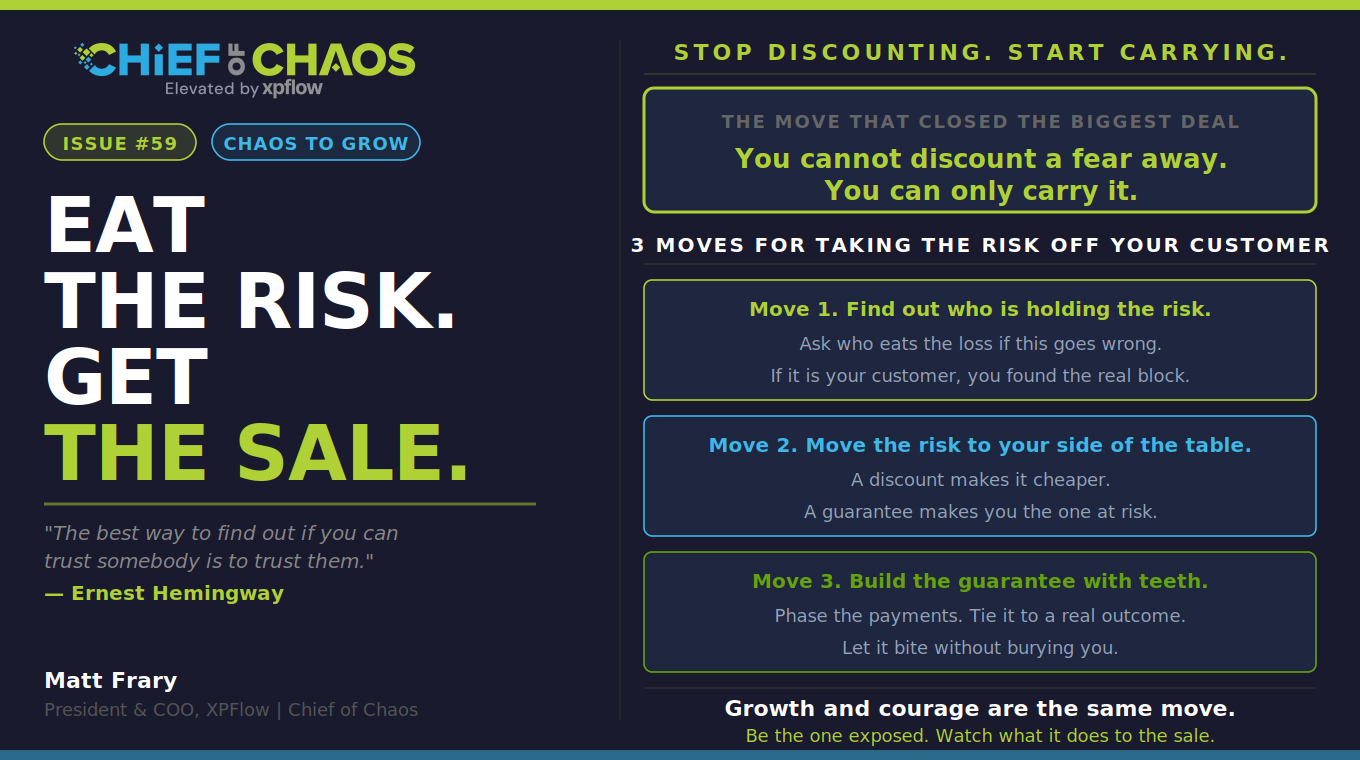
“The best way to find out if you can trust somebody is to trust them.” Ernest Hemingway
The biggest deal in the history of this company almost died in a chair.
Not over price. Over a silence. Everything on paper was perfect, and paper was never the problem. The problem was the thing nobody says out loud, the little voice every buyer hears right before they sign something big: what if I say yes and this thing does not work, and I am the sucker left holding the loss. That is not a pricing objection. You cannot discount your way out of a fear. I have watched founders try for twenty years, and it never once worked.
So we did the thing almost nobody reaches for first. We picked up the risk, walked it around to our side of the table, and set it down in our own lap. If it does not deliver, you get your money back. One sentence. And the whole room changed temperature. The question flipped from “what if I am wrong to trust them” to “wait, what do I actually have to lose here.” The answer was nothing. The deal that had been frozen for weeks closed that afternoon.
Now here is what made me sit up. That exact same week, at the complete opposite end of the business, we were having the identical fight over a tiny self serve signup. Whether to finally kill the free trial. Different money, different customer, same buried question every single time: who is carrying the risk in this deal, and what happens the moment we take it off them.
Let me give you the advice I wish one of the gray hairs had handed me twenty years ago, because gray hairs are experienced people, and this one took me way too long to learn. Whether you run an agency or you are building software, stop trying to argue your customer out of their fear. Learn to carry it for them. It is the most underused growth lever I know, and once you see it, you cannot unsee it.
What You’ll Get in This Issue
Why the thing killing your best deals is almost never the price, and why agencies and SaaS founders both misread it in the exact same way. The three moves for taking the risk off your customer and stacking it on yourself on purpose, with the specific play for services and the specific play for software. How to build a guarantee with real teeth that will never blow a hole in your cash flow. And the reason a bold guarantee will out close a discount every day of the week, and quietly make your whole company better while it does it.
Part One: The Fear Is the Deal
Here is the most expensive reflex in business, and I see it in agencies and software shops in equal measure.
A deal stalls, and the story we tell ourselves is that it costs too much. So we grab the discount, because the discount is the lever we already know how to pull. But go sit back in those rooms with me. The hesitation is almost never “that is more than I want to spend.” It is “what if I spend it and it flops.” Two completely different objections. And we keep answering the second one with a tool built for the first, then act shocked when the deal will not budge. You cannot discount a fear away. You can only carry it, or leave it sitting on your customer.
And listen, that discount reflex is quietly eating you alive. Every time you cut the price to soothe a nervous buyer, you are telling your own team the work is worth less than the number you just put on it. Do it once, it stings. Do it deal after deal, quarter after quarter, and you have built the whole company on a race to the bottom that undervalues your team and your software over, and over, and over, until your best people start believing their craft is nothing but a bargaining chip. That race has no finish line. Somebody is always willing to go cheaper, and if price is the only thing you are selling, they will eventually take the whole table. The way out is not down. It is to plant your feet, hold your number, and put your conviction behind it instead of your discount.
Because in a young company, your customer is already carrying every ounce of the risk. Look at what you are asking them to do. Pay first. Trust you can deliver. And if you cannot, eat the loss themselves. You are asking them to go first, on faith, with their money, into something unproven. Of course they hesitate. A smart person hesitates right there. The wonder is not that deals stall, it is that any of them ever close when the whole thing is built so the buyer swallows every downside. Good news: all of it is fixable, and the fix is always the same. Take the risk off them. Here is exactly how.
Part Two: The Playbook
Three moves for lifting the risk off your customer and putting it where it belongs, on you. None of them are about going soft. They are about being the one with the guts to go first.
Move 1: Find Out Who Is Actually Holding the Risk.
You cannot move the risk until you can see it, and it loves to hide behind a conversation about price.
So do this today. Take the deal you are fighting hardest to close and ask one blunt question: if this goes sideways, who eats it? Be honest. Nine times out of ten the answer is them. They pay first, commit first, stake their money and their reputation on your promise, and you have either already been paid or you lose nothing but a prospect you never had anyway. The risk is not shared. It is sitting almost entirely on the person you are asking to say yes.
Agency owner, here is where it hides on you. You send the retainer, they go quiet, and you assume they are price shopping. They are not. They are running the math on what happens if they pay you for three months and see nothing, and in their world that is not just wasted budget, that is their neck for hiring you. SaaS founder, stare down that free trial, because it is wearing a disguise. The customer is still spending their scarcest asset to protect themselves from you. Name it. You cannot fix an imbalance you refuse to look at.
→ Before you touch the price, ask who eats the loss if this goes wrong. If the honest answer is your customer, you just found the real thing blocking the sale.
Move 2: Move the Risk to Your Side of the Table.
Once you can see who is holding the risk, the move is simple to say and hard to do. Take it off them, and put it on you.
That is all a guarantee really is, and it is a completely different animal than a discount. A discount says “I will make the thing you are scared to buy a little cheaper.” A guarantee says “you are not the one taking the chance here, I am.” When we told our biggest client they could have their money back if it did not deliver, we did not shave a dollar off the price. We changed who was exposed. We took the downside off their books and stacked it onto ours. That is not a concession. It is a transfer, and the difference is everything.
So here is your play. Agencies: this is the boldest thing you can do in a room full of vendors who all sound identical. Tie your fee to the outcome, or put a real chunk of it at risk against the result. The day you stop selling hours and start guaranteeing outcomes, you climb out of the price fight entirely and start competing on conviction, which is a field most of your competitors are too scared to even walk onto. SaaS founders: kill the free trial and run pay first plus a money back guarantee. Read those two side by side. A free trial makes the customer risk their time to protect themselves from you. A guarantee lets them go all in while you risk your money to protect them. Same goal, opposite arrow. One asks the customer to hedge against you. The other is you betting on yourself, out loud, where they can see it.
→ A discount makes the thing cheaper. A guarantee makes you the one at risk. Stop marking down the fear and start absorbing it.
Move 3: Build the Guarantee With Teeth, Not a Death Wish.
Here is where most people flinch, so let me give you both halves, because this is the move that makes the whole thing real.
First, the teeth. A guarantee you would never actually have to honor is not a guarantee, it is a bumper sticker. The power lives in the fact that it can hurt. When we put our own money behind that deal, we were genuinely exposed, and everybody in the room knew it. That exposure is not a bug you tolerate to close. It is the whole engine. It is what makes the promise believable, and it is what keeps you honest, because a downside you personally have to eat is the finest forcing function ever invented for actually being great at your job. Write the coward’s version, the one buried in “results may vary” and a dozen escape hatches, and your customer smells it in a heartbeat. No teeth, no risk transferred, no trust earned. If offering it does not make you a little uncomfortable, you have not taken the risk off your customer. You have only told them you did.
Now the other half, because teeth are not the same as a death wish, and a guarantee that could sink you is not brave, it is just badly built. So build it to bite without bleeding you dry. Never hold the whole refund at once. Take the money in phases so your exposure at any moment is a single tranche, not the entire contract, and let the clawback shrink as you deliver, full in the first window and prorated after. Write it against a defined outcome you can measure, not a mood, and make it contingent on the client holding up their end, the data, the access, the time, so you are guaranteeing your own performance and not their participation. Offer a fix or a make good before you offer cash. And keep a reserve against the promise instead of spending guaranteed money like it is already yours. Do all of that and the guarantee still costs you when you fail, which is exactly the point, but a single refund dents a reserve instead of tearing a hole in payroll. One more thing: if a client keeps clawing the money back, that is not a flaw in your model, that is your model talking to you. Either the work is not landing and you just found your real problem, or you signed an account you never should have. Fix the first. Release the second.
→ A guarantee should be able to bite you, not bury you. Put it in phases, tie it to a defined outcome, and reserve against it, so it costs you when you fail without sinking you when it fires.
Part Three: What Carrying the Risk Actually Buys You
Here is the part I did not understand for years, so let me just hand it to you. A guarantee is not a sales tactic. It is the loudest statement of conviction you will ever make, and it upgrades you as much as it moves the buyer.
Think about what it actually says. A pitch is you telling the customer you believe in your work. Everybody says that, every competitor you have says that, so the words carry almost nothing. A guarantee is you betting your own money that you are right. That is not a claim, it is a stake, and a stake gets believed in a way a claim never will. This is exactly why the free trial quietly undercuts the founders who lean on it. A free trial whispers, under all that friendly wrapping, “I am not totally sure this is worth paying for, so you go check first.” A money back guarantee says the opposite, at full volume. “I am sure. So sure I will carry the entire risk of being wrong.” One is doubt in a generosity costume. The other is conviction wearing the risk on its sleeve. Your customer hears the difference even when they cannot name it.
But the best part is not even out there with the customer. It is in here, with your team, and this is where it gets fun. The second you hold your price and back the work with your own money instead of marking it down, you are telling the people who built it that you believe in what they made enough to bet on it. They feel that in a way no pep talk ever lands. Nothing rots a good team faster than watching the boss discount their work at the first frown, and nothing fires one up like watching him back it with conviction. And it sorts your market for you, for free. A guarantee does not move a tire kicker, because their whole game is the discount, the cheapest deal at any cost no matter the consequences. So they wander off, and you wave goodbye, because that buyer was always going to be your most expensive relationship, the one who pays the least, demands the most, and never once trusts the work. Not all business is good business. The race to the bottom does not just cost you margin, it packs your company with exactly the wrong people. Conviction weeds them out before they ever sign, and leaves you with the clients who actually value what you do.
→ A pitch is a claim. A guarantee is a stake. Put the downside on yourself and watch three things happen: the right customers lean in, the wrong ones leave, and your team finally sees you bet on them.
Your Weekly Chaos Challenge
Grab the one deal, offer, or product you are pushing hardest right now and answer a single question, honestly. If this goes badly, who carries the loss? Not who you hope. Who actually does.
If the answer is your customer, that is your week, and it is a good one, because you just found the lever. Do not reach for a discount. Agency, design the smallest real outcome you would stake a piece of your fee on. Software, sketch the pay first plus money back offer you have been too nervous to run. Give it teeth, and build it to survive: phase the payments, tie it to a number you can measure, reserve a little against it. Then take it to one customer and watch the whole conversation change. You are not making the thing cheaper. You are lifting the fear off their shoulders and setting it on yours, which is the one move that proves you mean every word.
→ Find the place your customer is carrying all the risk, and this week, take one real, structured piece of it onto yourself.
Final Thought
For years I thought closing was about persuasion. Say the right things, handle the objections, build the case so airtight they cannot say no. By that math a stalled deal is a failed argument, and the fix is always a sharper pitch or a lower price. I ran on that belief a long time, and it cost me deals I still think about.
What the years finally taught me, and what this week hammered home at both ends of my own business at once, is that the thing blocking most deals is not a weak argument. It is an honest fear. And you do not talk a person out of an honest fear. You take it off them. Your customer is not being difficult when they hesitate to go first, on faith, with their money, into something unproven. They are being reasonable, and every agency owner and every founder reading this has been that exact hesitant customer somewhere else. The move that respects that, and wins because of it, is not to convince them the risk is small. It is to pick the risk up and carry it yourself.
Yes, it is harder than a discount, and it should be, because it costs you something a discount never does. It puts your own money behind a promise you now have to keep. But that cost is the whole reason it works. It is the difference between telling someone you are trustworthy and simply going first, the way Hemingway meant it, extending the trust before you have a shred of proof they will not make you pay for it. And here is the good news, the part I want you to actually take with you: growth and courage turn out to be the same move wearing different clothes. Almost every real leap forward is just you deciding to be the one exposed. That is not a burden. That is the cheat code.
So go look at where you are quietly making your customer carry all the risk, from the biggest contract on your board down to the smallest signup in your funnel. Then ask if you have the conviction to carry it instead. If you do not believe in the work enough to stake your own money on it being right, good, you just found a much bigger and more useful problem than a stalled deal, so go fix that first. But if you do believe in it, and I suspect you do, then quit making them go first. Eat the risk, and watch what it does to the sale. That is a company worth building.
If you have ever won something by taking the risk off the other person instead of arguing them into it, hit reply and tell me what it was. I read every one.
Until next week.
Run toward the chaos.
Matt Frary Chief of Chaos // President & COO, XPFlow
#Leadership #FoundersJourney #SaaS #Agencies #ChaosToGrow