
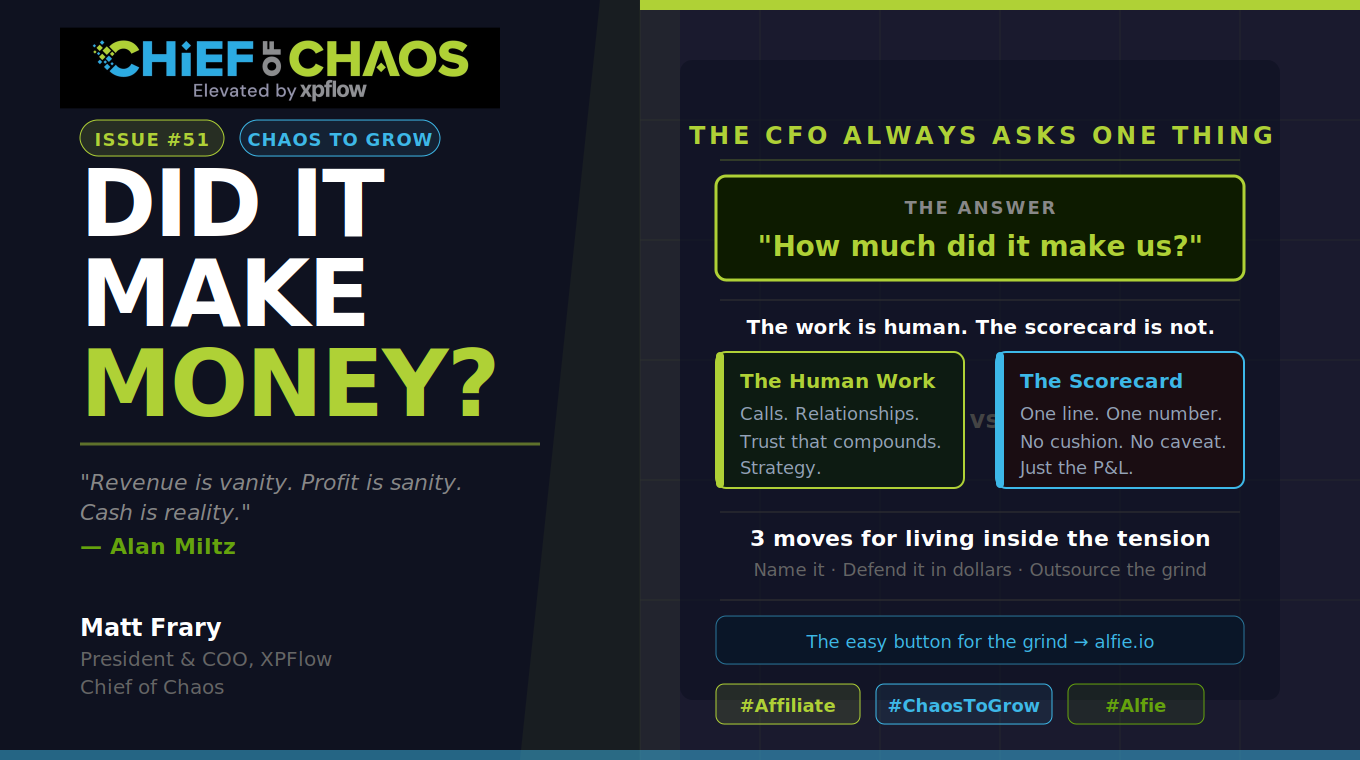
“Revenue is vanity. Profit is sanity. Cash is reality.” Alan Miltz
I spent this week in Dallas with my Alfie engineering team.
They are smart. Smarter than me, mostly, especially on the stuff I cannot read out of a stack trace. They kept asking me very thoughtful, very granular questions about how an affiliate manager actually works. “Does it matter if you respond to a partner the same day?” “How important is the first call versus the third?” “What separates a good recruitment outreach from a bad one?”
These are real questions. The answers matter.
But by Wednesday I had become the annoying guy in the room. Because no matter what they asked me, I kept circling back to the same four line answer.
“At the end of the day, the CFO or CMO of your client, or your direct boss, will inevitably try to distill everything you do down to how much money the affiliate program can be directly attributed to.”
I said it three times before it stopped sounding controversial. I have been saying that same line, in some form, for twenty seven years. It still does not get easier to say. And it still gets resisted, gently, every time I say it.
This is the most uncomfortable lesson I know how to teach, and I am still learning to teach it.
What You’ll Get in This Issue
A story about the tension at the heart of affiliate marketing, told by the guy who keeps having to remind his own engineers about it. Then three moves for living inside that tension without it killing the joy of the work. And a glimpse at the “easy” button we are building so you do not have to grind through the parts of the week that have nothing to do with relationships.
Part One: The Story
Here is the part that is not fair.
Affiliate marketing is the most relationship intensive job in the marketing org. Not close.
Brand teams pitch concepts. Paid media buys impressions. PR sends pitches. Email automates. SEO optimizes. Social posts and hopes for the best.
Affiliate calls a human. Asks how their week is going. Reads their content. Sends an actual personalized note. Negotiates a real economic agreement. And then, six weeks later, calls them again to ask how the offer landed and whether their audience showed up the way both of you thought they would.
It is the closest thing the marketing org has to enterprise sales.
That is also why it is the most rewarding job in the building. When it works, you have not just produced a quarter of revenue. You have built a long term sales channel and a real piece of human capital for the company. The partner relationships compound. The brand affinity compounds. The trust compounds.
And then, every quarter, the CFO sits down across the table from your CMO, and asks one question. Just one.
“How much money did the affiliate program make us?”
There is no “share of voice” pillow to land on. No “engagement score” cushion. No “ranking improvement” caveat.
Brand gets to point at share of voice. PR gets to point at earned media impressions. Social gets to point at engagement. Email gets to point at open rate. SEO gets to point at ranking. Product points at NPS. Customer success points at retention. HR points at engagement scores. Even some of the better organized brand and content teams get away with pointing at “consideration lift.”
Affiliate gets pointed at the line item on the P&L. Paid media is the only other function in the building that lives the same way, and even paid media gets to talk about brand halo when the dollar number does not sing.
The work is human. The scorecard is not. That mismatch is not going to be fixed by the next CMO, or the next platform, or the next category panel. Leadership is not going to apologize for the impatience. They are going to ask the question.
I have not solved that tension. I am not sure anybody can. But after twenty seven years of saying the same blunt thing to clients, bosses, and now my own engineering team in Dallas, I have a few moves for living inside it without burning out on it.
Part Two: The Playbook
Three moves. None of them are clever. The clever ones do not work. These do.
Move 1: Name the Tension Out Loud.
Tell your CMO, in plain language, that the work is relational and the scorecard is binary. Do not whine about it. Just name it. Then promise her the binary number, and quietly do the relational work that produces it.
The CMOs I have worked with longest are the ones I told the truth to first.
→ The tension is the job. Name it. Then live in it.
Move 2: Defend the Relationship Work. In Dollars.
Every hour you spend on a partner relationship is going to be questioned. The way to defend it is not by talking about the relationship. The way to defend it is to translate the relationship into dollars on a delay.
That partner conversation last quarter? It is the reason this quarter’s number is what it is. Show the bridge. “In Q1 we re engaged 28 dormant partners. Twelve of them are now in the top fifty by revenue. The work you are looking at on this line is what those partners produced in Q2.”
That is a sentence the CMO will repeat to her CFO. That is the sentence that buys you another quarter of relationship work.
→ Relational input. Dollar output. Show the bridge.
Move 3: Outsource the Parts of the Job That Do Not Need a Human.
This is the move I wish someone had handed me ten years ago.
Most of the affiliate manager’s week is not relationship work. Most of it is grinding. Finding the right partners in the first place. Hunting down contact info that actually opens. Sending the same recruitment template for the seventieth time this month. Chasing tracking links that broke. Updating spreadsheets that nobody reads.
That is the tax you pay to get to the rewarding part of the job. It is also the part of the job that gives affiliate management a bad name with everybody who has ever had to do it.
Knowing all of that, wouldn’t it be nice if the grinding part of the week went cleaner, smoother, simpler? Wouldn’t you want an “easy” button for the half of your day that has nothing to do with what your CFO is going to ask about?
That is what we are building at Alfie.
We started with recruitment. Find the right partners. Get contact info that actually works. Run the outreach. Move the conversation forward without you having to be the seventeenth tab open on your laptop.
Then we kept going. Alfie is becoming an Affiliate Work Companion. The kind of teammate that has read every program in the category and can tell you, in plain English, how to make more money with a specific partner this month, with decades of wisdom in the loop behind the recommendation.
Hand the grinding to software. Keep the relationship work for yourself. Spend the hours you save on the part of the job your CFO can actually see on a P&L line.
→ The human work is yours. The mechanical work is the easy button’s.
Your Weekly Chaos Challenge
Take an honest look at last week.
Estimate the hours you spent on the relational work (partner calls, content review, negotiation, strategy) versus the mechanical work (contact hunting, sending the same template, updating spreadsheets, chasing tracking).
If the mechanical work was more than 30% of your week, you are paying a tax that is keeping you from the part of the job that produces the number on the P&L.
→ Find the easy button. Stop paying the tax.
Final Thought
I have been saying the same blunt thing for twenty seven years and I still have to say it at least once a week. To clients. To bosses. To engineers in Dallas who probably wish I would stop saying it.
The work is human. The scorecard is not. That mismatch is not going away.
What is going away, finally, is the grinding part of the job that has been keeping affiliate managers from doing the human work they are actually good at.
That is the easy button. We are building it.
If you have a “I keep having to say the same thing to my CMO” story of your own, hit reply and tell me. I read every one.
Until next week.
Run toward the chaos.
Matt Frary, Chief of Chaos
President & COO, XPFlow
#AffiliateMarketing #PartnershipEconomy #PerformanceMarketing #CMO #Leadership #Alfie #ChaosToGrow