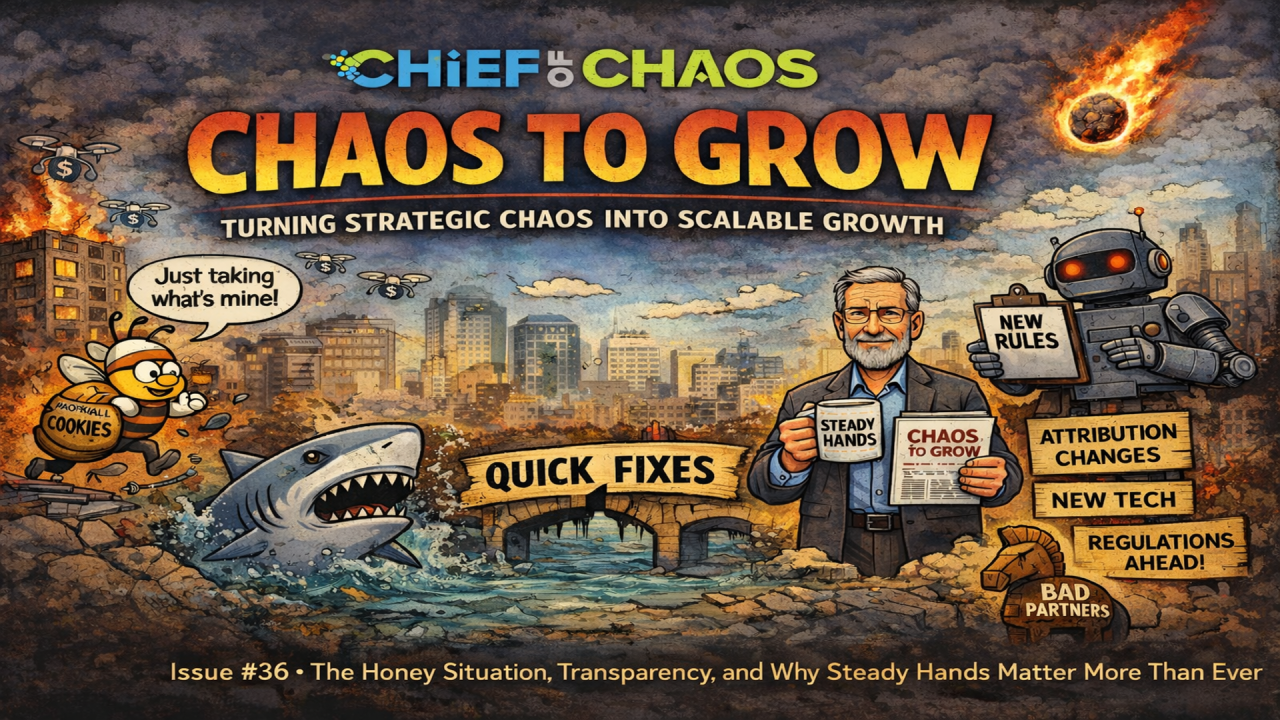
“The price of light is responsibility.”
— Winston Churchill
This issue is landing a day later than usual.
That was intentional.
Between Affiliate Summit, getting home, and letting the noise settle, it became clear that what’s happening in affiliate marketing right now deserves a calmer, more useful conversation than most of what’s circulating.
Because the Honey situation isn’t just about Honey.
It’s about how rules are enforced, how value is defined, and who should be trusted to guide brands through moments like this.
What You’ll Get in Chaos to Grow
• A clear, plain-English summary of the Honey situation
• Why enforcement without transparency creates risk
• What brands should be doing right now
• How inexperience quietly costs brands millions
• Why durable growth requires steady leadership
The Honey Situation, Explained Simply
For anyone who hasn’t been paying close attention, here’s the straightforward version.
PayPal Honey was suspended or terminated by multiple major affiliate networks, including Rakuten Advertising and Impact, over allegations of attribution manipulation, often referred to as cookie theft.
In practical terms, Honey is accused of:
• overwriting existing affiliate tracking near checkout
• taking credit for conversions it did not meaningfully influence
• behaving differently during compliance testing than for real users
• monetizing merchants without delivering clear incremental value
Whether you like Honey or not is beside the point.
The issue is whether the value being credited matched the value being created.
Why Networks Acted When They Did
This wasn’t sudden.
What changed was evidence and exposure.
Recent investigations included:
• actual affiliate contracts
• documented violations of promo-code and attribution clauses
• behavior that conflicted with stated platform policies
At that point, networks had two choices:
enforce their own rules
or accept reputational and legal risk
They chose enforcement.
That decision itself isn’t controversial.
The Transparency Gap the Industry Is Feeling
Here’s where legitimate concern comes in.
Rakuten terminated Honey.
But Rakuten Rewards is also a toolbar.
So fair questions remain:
• What specific behaviors crossed the line?
• How is Honey materially different from other extensions?
• Which attribution mechanics are now unacceptable?
• What guardrails exist elsewhere?
Similarly, we’re hearing about other coupon and extension partners being suspended on Impact, but without much public detail.
Naturally, brands and publishers are asking:
• Who else was affected?
• What exactly did they do wrong?
• Were violations accidental, incremental, or systemic?
Enforcement without clarity doesn’t build confidence.
It creates uncertainty.
This should feel like a course correction, not a mass sacrifice.
What Brands Should Be Doing Right Now
Instead of debating headlines, here’s where to focus.
1. Audit Coupon and Extension Partners for Incrementality
Ask:
• Are they adding value before checkout?
• Or only appearing at the moment of conversion?
If the answer isn’t clear, the risk isn’t theoretical.
2. Revisit Stand-Down and Promo-Code Rules
Most problems don’t come from bad intent.
They come from outdated assumptions.
Confirm:
• who can promote which codes
• where codes can appear
• what happens when rules are violated
3. Pressure-Test Your Attribution Model
If you can’t explain it clearly to leadership, it’s too fragile.
Attribution that only works when nothing goes wrong isn’t attribution.
It’s hope.
4. Watch Patterns, Not Just Revenue
Revenue won’t warn you early.
Look for:
• checkout-stage dominance
• sudden conversion spikes
• overlapping partner behavior
Patterns matter more than payouts.
5. Balance Your Partner Mix
Programs overly dependent on one partner type break first when enforcement tightens.
Healthy programs include:
• content and editorial
• creators and media
• loyalty and incentives
• technology partners
Diversification is stability.
Why This Moment Calls for Steady Hands
This was the strongest takeaway for me after Affiliate Summit.
Most affiliate damage isn’t caused by bad actors.
It’s caused by inexperience combined with pressure.
Pressure to show growth fast.
Pressure to hit numbers.
Pressure to make charts go up.
That’s when shortcuts get justified.
Inexperienced agencies and junior managers are often incentivized to optimize for what looks good on paper, not what holds up over time.
That can quietly lead to:
• aggressive incentive stacking
• tolerance of questionable partners
• margin erosion
• misattributed revenue
• long-term brand damage
On a dashboard, it looks like growth.
In reality, it can cost brands millions.
The Difference Between Growth and Illusion
There’s a real difference between:
growth that survives scrutiny
and growth that disappears when rules change
Experienced operators don’t need to experiment with your brand.
They’ve seen these cycles before.
They know true value-added partnerships take time, alignment, and investment.
And they build programs that can withstand audits, enforcement, and market shifts.
That’s not slower growth.
That’s durable growth.
Your Chaos Challenge This Week
Ask yourself one honest question:
If my affiliate program were audited tomorrow, would our growth still make sense?
If the answer is unclear, that’s exactly where to focus.
Final Thought
Moments like this don’t break strong programs.
They reveal weak ones.
Affiliate marketing isn’t disappearing.
It’s maturing.
And in moments of transition, experience, judgment, and transparency matter more than ever.
Build for that.
If you’d like, we’ll do a brand audit of your affiliate program for FREE and uncover any hidden obstacles.
Or, Join Our Growing waitlist for The School of Chaos and be a part of the community driving this industry at www.schoolofchaos.com
Let’s Grooooooooow!
—Matt Frary
Chief of Chaos