
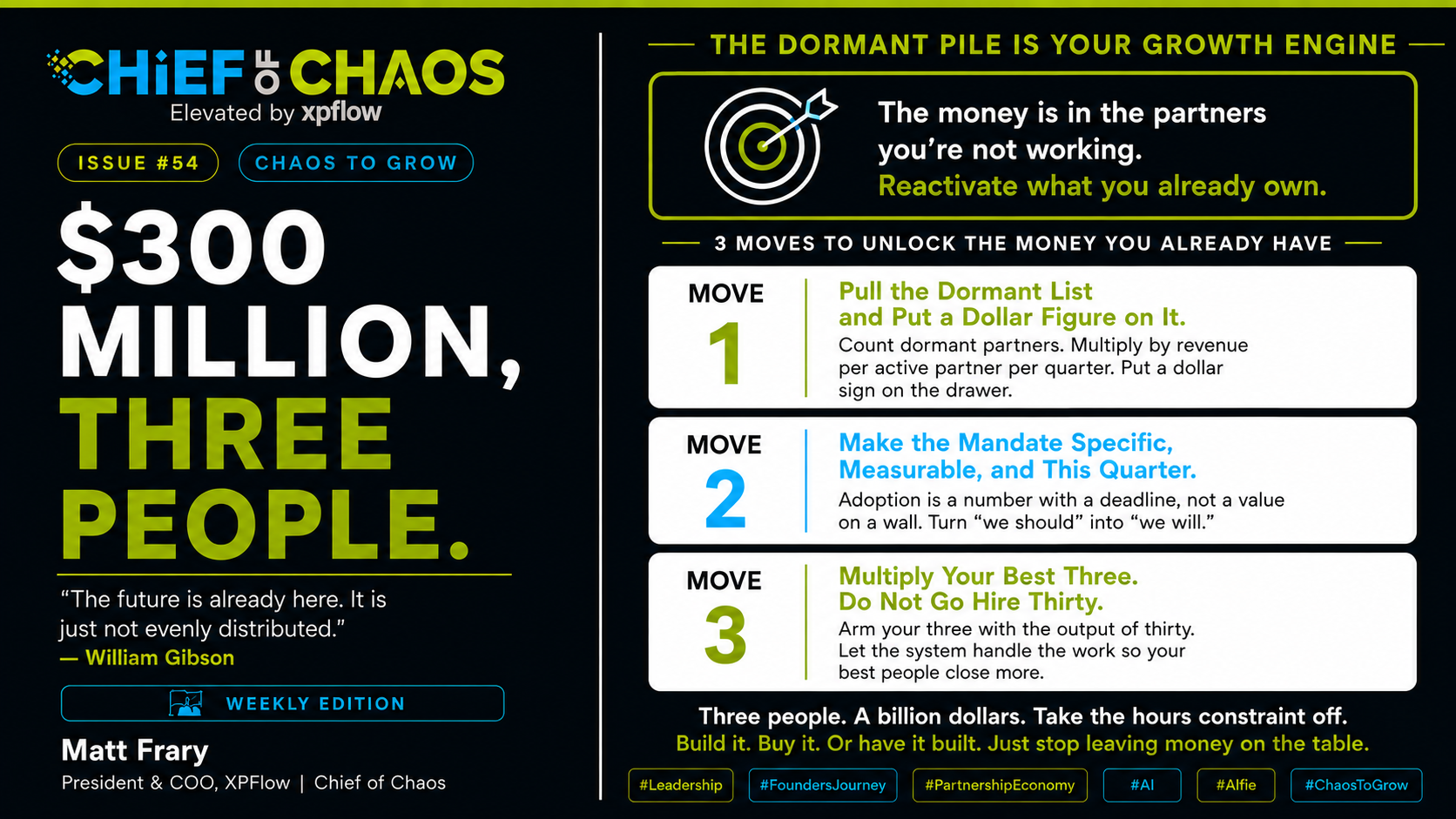
“The future is already here. It is just not evenly distributed.” William Gibson
Here is a number that should stop you cold.
There is a partner program I am close to that drives north of $300 million a year in revenue. Affiliates, partners, referrers, the whole motion. Three hundred million dollars.
It is run by three people.
Not three hundred. Not thirty. Three. And the mandate they just got handed is to double it inside eighteen months without tripling the team.
Sit with that for a second, because the math is the whole story. A strong affiliate manager can actively manage somewhere between 50 and 75 partners before relationships start going cold. Past that ceiling, partners go dark and nobody notices for a quarter. Three people at the absolute ceiling is maybe 225 active relationships.
That program has thousands of signed partners.
So the real number underneath the $300 million is this: the overwhelming majority of their partners are sitting dormant right now, not because they are bad partners, but because there are not enough human hours in the week to call them. That is not a Retailer A problem. I have audited dozens of programs and the pattern is identical every time. Somewhere between 60 and 80 percent of signed partners have not driven a dollar in 90 days.
That dormant pile is the single largest source of found money in this entire industry. And until about a year ago, there was no way to go get it.
That is the issue this week. The number, the money sitting inside it, and exactly what I would do about it on Monday morning.
What You’ll Get in This Issue
The math that turns a vanity headcount stat into the clearest growth opportunity on your books. Three moves you can run this week, with the actual numbers I would look for. The three ways to arm your team so the same people produce three times the number. And the reason the teams who internalize this are about to eat the teams who do not.
Part One: The Money in the Dormant Pile
Stop thinking about the $300 million. Start thinking about the partners who are not in it.
Every partner program is two programs stacked on top of each other. The visible one is the 5 to 10 percent of partners driving almost all the revenue. The invisible one is the 90 percent who signed up, maybe drove a sale once, and then went quiet because nobody had the hours to keep them warm.
The visible program is what the three people manage. The invisible program is what they cannot get to. And the invisible program is usually worth more than the visible one, because reactivating a partner who already knows your brand converts three to five times better than recruiting a cold one.
Run the numbers on your own program right now. If you have 2,000 signed partners and 150 are active, you do not have a recruiting problem. You have 1,850 relationships you already paid to acquire, sitting in a drawer. At even a 10 percent reactivation rate, that is 185 partners back in the mix, each one cheaper and faster than anyone your team could go recruit cold this quarter.
And do not let the $300 million number convince you this is a big-company problem. It is the opposite. Picture a $10 million brand with one person running partnerships part time, 300 signed partners, and maybe 30 of them active. Same two programs stacked on top of each other. Same dormant drawer. Except for the $10 million brand, reactivating 30 sleeping partners is not a rounding error, it is a visible jump in the growth plan the founder is presenting to the board next quarter. The percentages do not care how much revenue you do. They are the same at $10 million and at $300 million. The only thing that changes is how many zeros are on the money you are leaving in the drawer. If anything, the smaller you are, the more that drawer is worth to you, because every reactivated partner is a bigger slice of your total.
The reason nobody does this is not strategy. It is hours. Reactivating 1,850 partners means 1,850 personal, specific, non-generic touches, and then a second one, and then a third. No human team of three is doing that. They physically cannot.
A system can. That is the entire shift. The hours constraint that has capped this industry since it started is the constraint that just came off.
Part Two: The Playbook
Three moves you can run this week. Each one has a number attached, because vague advice is worthless and you already have enough of it.
Move 1: Pull the Dormant List and Put a Dollar Figure on It.
Before you do anything else, quantify the drawer.
Export every partner who drove revenue in the last 24 months but has driven zero in the last 90 days. That is your reactivation list. Now multiply that count by your average revenue per active partner per quarter. That number, the one you just calculated, is the money sitting dormant on your books right now.
I have watched operators do this math for the first time and physically sit back in their chair. It is almost always a seven figure number hiding behind a “we need more partners” conversation.
Do not skip the dollar figure. The count is interesting. The dollar figure is what gets the budget approved.
→ You cannot reactivate what you have not counted. Put a dollar sign on the drawer first.
Move 2: Make the Mandate Specific, Measurable, and This Quarter.
The companies pulling away are not the ones with the best tools. They are the ones whose leader turned adoption into a number instead of a suggestion.
“We should use more AI” gets you a dead pilot in a side channel. Try this instead, out loud, in the next leadership meeting: “By the end of this quarter, every person on this team ships one workflow that takes something off their own plate, and we are going to measure the hours it gives back.”
Now it is real. Now it has a date, an owner, and a metric. The handful of people holding up your huge number stop waiting for permission and start hunting for leverage themselves, because you made it the job instead of the bonus round.
A suggestion is a wish. A mandate with a date is a strategy.
→ Adoption is a number with a deadline, not a value on a wall. Assign it this week.
Move 3: Multiply Your Best Three. Do Not Go Hire Thirty.
When the dormant-pile number lands, the instinct is to staff up. Resist it. Thirty new hires is thirty people who each take six months to get good and a payroll line that outlives the opportunity.
Your three people are the most valuable asset in the building. They carry the pattern recognition for which partners convert, which ones leak money, and which outreach actually gets answered. Do not dilute that with thirty juniors. Arm it.
Give your three the leverage to run 2,000 relationships at the quality they currently run 200. Let the system handle the first, second, and third touch, the dormant-partner reactivation, the “haven’t heard from you in 60 days” note, and route only the live, high-value conversations to the humans who are great at them. The job stops being “manage partners” and becomes “close the ones the system warmed up.”
That is the difference between automation that scares your best people and automation they fight to get their hands on. One replaces them. The other turns three people into the output of thirty without the payroll, the ramp, or the dilution.
→ Hand your three the output of thirty. Multiply the talent you have, do not water it down.
Part Three: From $300 Million to a Billion
Now the part that should actually excite you.
If three people maxed out by hand are holding up $300 million, the ceiling was never the talent. It was the hours. Take the hours constraint off those same three people and the question stops being “how do we protect $300 million” and becomes “how high can these three actually go.”
Work the full partner base instead of the top 200. Keep every dormant partner warm with a touch that sounds like a human wrote it. Let the system handle the first, second, and third outreach and route only the live, ready-to-close conversations to the people who are great at closing. Do that, and a billion dollars in partner revenue through the same three people is not a fantasy. It is arithmetic. Very possible.
There are three ways to get there, and the right one depends almost entirely on your size.
Build it yourself. If you have engineering capacity and the patience, you can stand up your own automated workflows. Partner scoring, dormant reactivation sequences, first-touch outreach, performance flags. It works. It is also slow, and your engineers already have a roadmap that is not this. This path is for the larger shops with people to spare. If you are a $10 million brand, do not even consider it. You do not have the engineers, and you should not want to.
Buy it off the shelf. This is exactly why we built Alfie.io, and it is the right answer for almost everyone under nine figures. It is purpose built for this motion. It finds partners, works the dormant pile, drafts the outreach in your team’s actual voice, and hands your one person, or your three, live conversations that are ready to close. The afternoon exercise from Move 1 is the first thing it runs for you. A $10 million brand can be working its entire dormant drawer by next week for less than the cost of the part-time hire it was about to make.
Have it built for you. If your program is complex enough that off the shelf will not cut it, this is the work XPFlow and companies like ours do. We build custom AI workflows around your specific program, your data, your partners, your compliance rules, and wire them into the tools your team already uses. This is the three-people-to-a-billion path for the bigger operations, built to fit your business instead of the other way around.
Pick the path that matches your size. But pick one. The operators who keep treating this as a someday decision are going to watch a competitor with the same three people put up triple their number, and wonder how.
→ Build it, buy it, or have it built. Just stop leaving the hours on the table.
Your Weekly Chaos Challenge
Do Move 1. This week. It takes an afternoon.
Pull your dormant list. Count it. Multiply it by revenue per active partner. Write the dollar figure on a sticky note and put it where you make decisions.
When that number is staring at you, the “do we invest in this” conversation is over. You will have found more money in your own database than your team could recruit cold all quarter.
→ Count the drawer. Put a dollar sign on it. Then come find me about how to go get it.
Final Thought
I have been in this category a long time. I have watched it get re-platformed, re-branded, and re-imagined more times than I can count. Most of those waves were noise.
This one is not.
Three people running $300 million is not a story about three impressive people, although they are. It is a story about a ceiling that has capped this entire industry since it began, the ceiling of human hours, finally coming off. The programs that figure out how to reactivate the 90 percent sitting in the drawer are about to put up numbers that look impossible to the programs still trying to recruit their way out of it. The same three people, armed correctly, at a billion dollars. I am not being cute with that number. I have run the math and it holds.
That is the company I am building for. Not the logo. The three people holding up the huge number by hand, who are about to find out what they can do with both hands free, whether they build the leverage themselves, run it on Alfie, or have us build it for them.
The drawer is full. The hours just stopped being the reason you cannot open it.
If you run Move 1 this week and the number surprises you, hit reply and tell me what you found. I read every one.
Until next week.
Run toward the chaos.
Matt Frary Chief of Chaos // President & COO, XPFlow
#Leadership #FoundersJourney #PartnershipEconomy #AI #Alfie #ChaosToGrow