
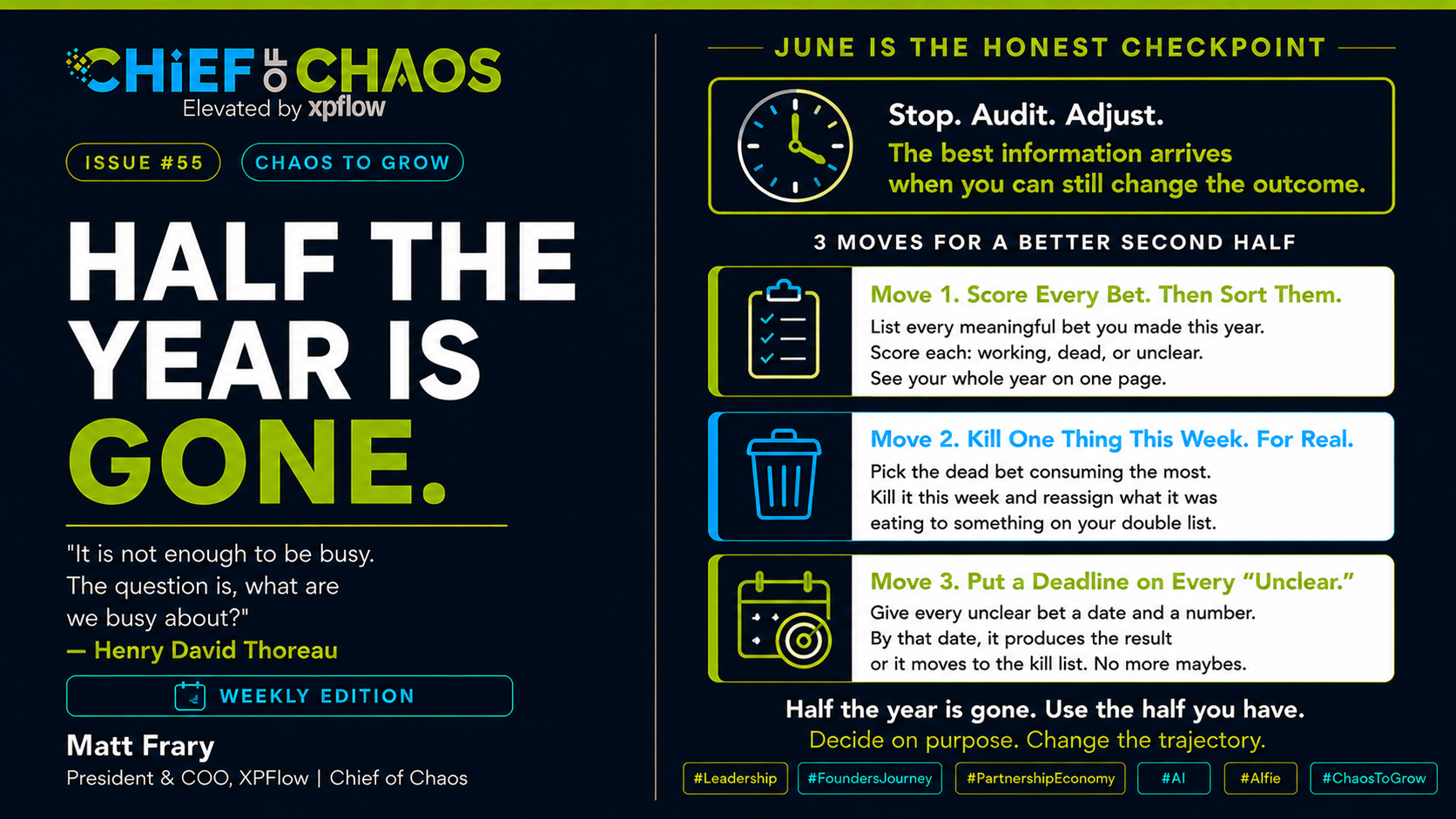
“It is not enough to be busy. The question is, what are we busy about?” Henry David Thoreau
It is June 9th.
I want you to do something uncomfortable before you read another word. Pull up the plan you wrote in January. The real one. The goals, the headcount, the revenue number, the three big bets you swore this was the year for.
Read it like a stranger wrote it. Because in a way, a stranger did. The version of you from January did not know what you know now.
Here is the thing about June. It is the most honest month of the year and almost nobody uses it that way. January is fantasy. You set the number high because hope is free in January. December is theater. You spin whatever happened into a story for the board. But June, June is the only month where the year is half spent and half remaining at the same time. You have enough data to know if the plan is working and enough runway to do something about it.
Most founders waste it. They feel the year slipping, get a little anxious, work a little harder at the same things, and tell themselves Q3 is when it all comes together. Then Q3 becomes Q4, Q4 becomes a scramble, and the honest reckoning gets pushed to next January, where it becomes fantasy again.
That is the loop. This issue is about breaking it.
The half-year point is not a milestone to note in passing. It is a checkpoint to stop at on purpose. So today I am going to walk you through the exact audit I run on my own businesses in June, the one that tells me what to kill, what to double, and what I have been quietly lying to myself about since spring.
It takes thirty minutes. It is the highest-leverage half hour you will spend this quarter.
What You’ll Get in This Issue
Why June is the only honest checkpoint on the calendar and the trap that makes founders waste it every single year. The thirty-minute mid-year audit I run on my own businesses, broken into three moves you can do today. And the reason the back half of the year belongs to the operators who are willing to look at the scoreboard before it is too late to change the score.
Part One: The Lie You Tell Yourself in Spring
Every plan rots. The question is whether you notice while you can still do something about it.
In January you made a set of bets. Some of them were right. Some of them were wrong the day you wrote them down, you just could not know it yet. And a few of them were right in January and have quietly gone wrong since, because the market moved, a hire did not work out, a channel dried up, or a bet you were sure about turned out to be a feeling dressed up as a strategy.
Here is the part that gets founders. None of those bets announce themselves when they go bad. A failing initiative does not send you a calendar invite. It just keeps consuming hours, budget, and one of your best people, looking busy the whole time, returning almost nothing. Busy is the disguise. The thing draining your year looks exactly like work because it is work. It is just work pointed at the wrong target.
The reason this survives until December is that nobody wants to be the person who killed the thing. There is a sunk cost in every dying initiative, and the deeper the sunk cost, the harder it is to say the words out loud. You have spent six months and real money. Calling it now feels like admitting the six months were wasted. So you give it one more quarter. And the one more quarter is how a wasted six months becomes a wasted year.
June is your chance to short-circuit that. Not because anything is on fire. Because nothing is, yet, and you have the distance to see clearly. The founders who pull away in the back half are not the ones who worked hardest in the first half. They are the ones who were willing, in the quiet of June, to look at the scoreboard and tell the truth about what it says.
The audit below is how you do that without flinching.
Part Two: The Thirty-Minute Mid-Year Audit
Three moves. Do them in order. Give yourself thirty uninterrupted minutes and a blank page. No deck, no team, no performance. Just you and the truth.
Move 1: Score Every Bet Honestly. Then Sort Them Into Three Piles.
Write down every meaningful bet you made for this year. The initiatives, the hires, the channels, the products, the big customers you were chasing. All of them on one page.
Next to each one, put a single word: working, dead, or unclear. Not the polite version. The real one. If you find yourself writing a sentence to justify a “working,” it is not working, it is unclear at best. The honest answer fits in one word and you know it before you finish reading the line.
Most founders have never seen their whole year on a single page like this. The act of putting it all in one place is half the value, because you stop evaluating each bet in isolation, where everything looks defensible, and start seeing them next to each other, where the dead ones have nowhere to hide.
When you are done, you will have three piles. The working pile is your double list. The dead pile is your kill list. The unclear pile is the most dangerous one, because that is where the year goes to quietly die. We deal with it in Move 3.
→ You cannot fix a year you have never seen on one page. Score every bet in one word.
Move 2: Kill One Thing This Week. For Real.
Look at your dead pile. Pick the one that is consuming the most of your best resources, time, money, or your strongest person, and end it this week.
Not wind it down. Not revisit it next quarter. Kill it, and reassign what it was eating to something in your double list.
This is the move everyone skips, and skipping it is the whole problem. A kill list that never gets executed is just a worry list. The relief you are looking for, the sense that you have actually changed the trajectory of the year, does not come from making the list. It comes from the first thing you take off the board.
And watch what happens to the freed resource. The best person you had trapped in a dying initiative does not just get their hours back, they get their belief back. People know when they are working on something that is not going anywhere. Pulling them off it and pointing them at something live is one of the highest-trust moves a leader can make. You are telling them their time is too valuable to spend on a corpse.
One kill. This week. Then feel how much lighter the second half already is.
→ A kill list you never execute is just a worry list. Take one thing off the board this week.
Move 3: Put a Deadline on Every “Unclear.”
The unclear pile is where founders lie to themselves most. “Unclear” feels safe. It is not a failure, it is not a commitment, it is a comfortable maybe that lets you avoid the decision for another quarter.
So take the comfort away. Next to every unclear bet, write a date and a number. By this date, this initiative will have produced this result, or it moves to the kill list. No more open-ended maybes. Every unclear thing gets a checkpoint with teeth.
This does two things. It forces the bet to prove itself on a clock instead of drifting, and it pre-makes the hard decision so future-you does not have to find the courage again in September. You decided in June, with a clear head, exactly what evidence would make you walk away. When the date arrives, you are not making an emotional call under pressure. You are just reading the result against the line you already drew.
The unclear pile is where most of your year is hiding. A date and a number is how you get it back.
→ “Unclear” is a decision you are avoiding. Give every maybe a date and a number.
Part Three: Where the Hours Go Next
Here is the part that turns an audit into actual leverage.
When you run these three moves, you are going to free up something. Hours, budget, a person, attention, all of it. The kill list returns resources you had forgotten were even committed. The instinct is to pour all of it straight back into the double list and grind harder at what is already working.
Do that, but ask a sharper question first. Of the work that survived the audit, how much of it actually needs you, or your best people, doing it by hand? Because the most common thing I find in a working pile is a working initiative that is working in spite of being held together by manual effort that should not be manual anymore.
This is the trap I watch good operators fall into every June. They run the honest audit, they kill the dead weight, they free up their best person, and then they hand that person another pile of the same kind of manual work that was burning them out in the first place. They protected the year and re-created the bottleneck in one move.
The half-year reset is the perfect moment to ask the second question, the one most people skip. Not just “is this bet working,” but “if it is working, is a human doing the part a system should be doing?” The dormant-partner outreach that your best manager does by hand. The first, second, and third touch that eats half her week. The reporting nobody should be assembling manually in the back half of 2026. The reset is not just about cutting what is dead. It is about making sure what survives is built to scale, instead of built to consume the very people you just freed up.
That is the difference between a founder who ends the year tired and a founder who ends it with more capacity than they started. Both ran the audit. Only one asked where the freed hours were going next.
→ Do not pour freed hours back into manual work. Audit what survives, then build it to scale.
Your Weekly Chaos Challenge
Thirty minutes. This week. A blank page and the plan you wrote in January.
Run the audit. Every bet on one page, one word each. Sort them into working, dead, and unclear. Then do the only part that counts: kill one thing off the dead pile this week, and put a date and a number on everything in the unclear pile.
That is it. You will end the week having done what most founders will not do until it is too late to matter. You will know exactly what the back half of your year is for.
→ Put the whole year on one page. Kill one thing. Date every maybe.
Final Thought
I used to treat June like a speed bump. Note that the year was half gone, feel a flash of pressure, and keep driving at the same speed in the same direction. I lost more than one year that way. Not to a disaster. To drift. To a plan that quietly stopped being true sometime in the spring while I was too busy executing it to notice.
The years that turned out well were the ones where I stopped in June and told the truth. Where I looked at the bets that were not working and ended them while there was still half a year to redeploy. Where I stopped protecting the sunk cost and started protecting the runway.
Half the year is gone. That is not a reason for anxiety. It is the best information you are going to get all year, arriving at the exact moment you can still do something with it. December tells you what happened. June lets you change it.
So pull up the plan. Read it like a stranger wrote it. And give yourself the half hour to decide, on purpose, what the rest of this year is going to be about.
If you run the audit this week and something surprises you, hit reply and tell me what you found. I read every one.
P.S. I’m in Austin This Week
I am heading to Impact.com’s iPX in Austin this week, and I cannot wait. This is the room where the industry’s best and brightest actually show up, and I plan to spend the week shaking hands, comparing notes, and yes, bragging shamelessly about what we are building with Alfie.
So here is a standing offer. I will take anyone who wants to go to Terry Black’s BBQ. Brisket is on me. The only entrance fee is that you have to let me show you how we are automating affiliate recruitment, finding partners, working the dormant pile, and drafting outreach in your team’s actual voice, so your best people spend their hours closing instead of chasing.
If you behave, I might even tell you about the Spartan Race I ran last weekend. If you have ever wondered what the mid-year audit looks like applied to a human body, I have some thoughts and a few bruises.
If you are going to be in Austin, find me. Or hit reply and we will set a time before the week fills up.
Until next week.
Run toward the chaos.
Matt Frary Chief of Chaos // President & COO, XPFlow
#Leadership #FoundersJourney #PartnershipEconomy #AI #Alfie #ChaosToGrow