
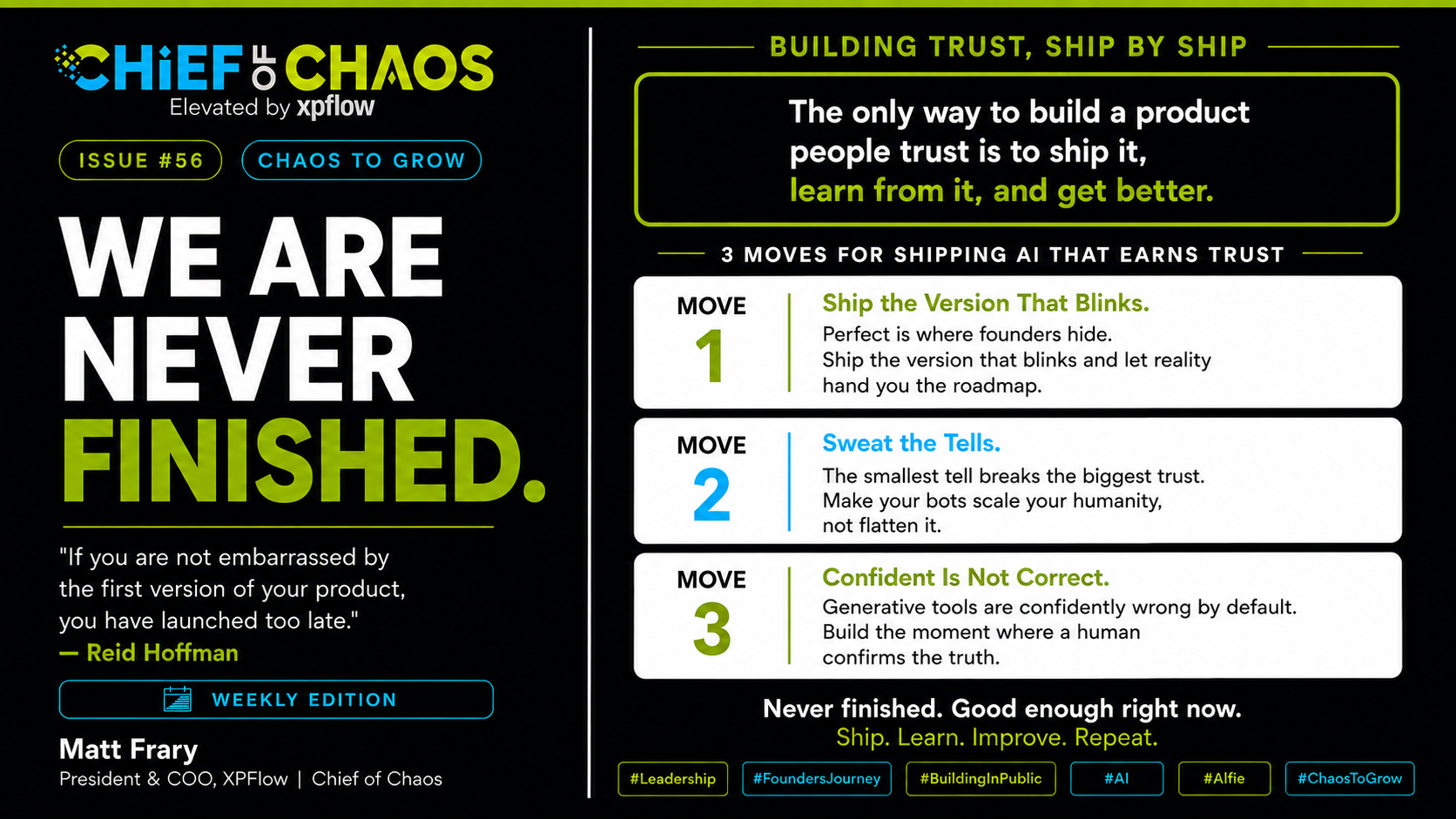
“If you are not embarrassed by the first version of your product, you have launched too late.” – Reid Hoffman
This issue is late. I am going to tell you why, because the reason is the whole lesson.
We were shipping.
Over the last few weeks at XPFlow we pushed a major new version of Alfie out the door. First to our own team, then to a room full of the best operators in our industry, and now toward the market. The newsletter slipped because the product did not. Given the choice, I will take that trade every week.
I want to use this issue to be honest about what the build taught me, because the lessons travel a lot further than the product does. If you are building anything with AI right now, and most of you are, these three are the ones I would tattoo on the inside of my eyelids.
A quick bit of context so the rest lands. The new Alfie is a matching agent and workflow engine for affiliate managers. The job it does is simple to say and hard to do. Help an affiliate manager find the right partners, get them live, and convert them into revenue. The promise we make is five minutes a day. That promise shaped almost every decision that followed.
Here is what I am taking with me.
What You’ll Get in This Issue
A reflection on the most uncomfortable and most valuable thing a founder can do, which is hand an unfinished product to the people most qualified to tear it apart. Three moves for shipping AI that earns trust instead of burning it. And the mindset that lets you be never finished and good enough on the very same day, without those two things being in conflict.
Part One: Good Enough Is a Decision
There is a version of this company that is still in a conference room arguing about whether Alfie is ready.
That version never ships. It polishes. It waits for the feature that will finally make the product undeniable, and while it waits, the calendar keeps moving and the market keeps not caring about the thing that has not launched.
We made a different decision. We decided that good enough is a decision, not a feeling. We decided Alfie was good enough to put in front of real people, knowing full well it was not finished, because finished is not a real place. So we shipped a version one, opened it to every set of eyes inside the company, and told them to break it.
Then we did the part that actually took nerve. We brought in a community of the best operators in affiliate marketing, some of the genuine who’s who of this industry, and asked them to test it, push on it, and pull it apart. These are people who have seen every tool and every empty promise the space has ever produced. Handing them an unfinished product is a vulnerable thing to do. It is also the single fastest way to find out whether you have built something real or just something pretty.
What came back was worth more than another quarter of internal guessing. One of the most experienced affiliate people in our orbit came back with a version of “this is light years better, the leads are better, the process is better.” We would not have known that, and we would not have known what to fix next, if we had waited for perfect. Perfect is a place founders hide. Shipping the thing that is good enough is how you find out what actually works.
That is the decision underneath everything below. Now here is how we are trying to make the thing worthy of the people testing it.
Part Two: The Playbook
Three moves for shipping AI that earns trust. None of them are clever. The clever ones do not survive contact with real users. These do.
Move 1: Ship the Version That Blinks.
When we put the new Alfie in front of people, I did not frame it as a finished product. The message was closer to “break it, push it, tell us where Alfie blinks instead of winks.”
A founder’s instinct is to present the polished thing and absorb the feedback privately. That instinct is the enemy of speed. The feedback you get from real operators in the first week of an honest version one is more valuable than anything you can generate inside your own building, because your building is full of people who already believe. The people who do not believe yet are the ones who will tell you the truth.
Ship the version that blinks. Then treat every place it blinks as your roadmap, handed to you for free by the only people whose opinion the market will ever actually price.
→ Perfect is where founders hide. Ship the version that blinks and let reality hand you the roadmap.
Move 2: Sweat the Tells.
Here is my favorite moment from the whole cycle, and it is tiny. Someone flagged that Alfie was writing outreach emails with dashes in them. The note was simple. A dash is a tell that a machine wrote the message, and in outreach that tell quietly kills your credibility.
It sounds like a nitpick. It is not. When your product writes on someone’s behalf, the goal is not for the output to be impressive. The goal is for it to be trusted. A single giveaway that says “a robot wrote this” can undo all the intelligence underneath it.
I want to be clear about where I stand, because I build automations and I build AI. This is not a warning against the tools. It is a reminder that one slip can cost you a relationship you never get back. There is a real difference between high volume outreach, where the exchange is transactional and both sides win regardless, and the work of building genuine credibility, where you have to stay buttoned up and intentional every single time. Use the tools at full power in the first case. Treat them like a loaded instrument in the second. Either way, the bot should be scaling your humanity, not flattening it. If your automation is making you less human, you have pointed it in the wrong direction.
→ The smallest tell breaks the biggest trust. Make your bots scale your humanity, not flatten it.
Move 3: Confident Is Not Correct.
This lesson cost us nothing to learn and would have cost us plenty to ignore.
When a new user does not have an offer page, Alfie builds one. To do that, it fills in defaults. A payout percentage, a cookie window, the usual placeholder terms. The output looks authoritative. It reads like fact. And for that specific business, it is very often wrong.
That is the trap with every generative tool on the market. They fill each gap with something plausible and present all of it with the same steady confidence, whether it is true or invented. Confidence is not the same as correct, and your users cannot always tell the difference by looking. Our job as builders is to design the exact moments where a human has to confirm the truth, instead of letting a confident default slide through as gospel.
The feature is not the AI generating the page. The feature is the AI knowing what it does not know, and asking.
→ Generative tools are confidently wrong by default. Build the moment where a human confirms the truth.
Your Weekly Chaos Challenge
Find the thing you have been holding back for polish.
The feature, the page, the offer, the product you keep telling yourself needs one more pass before anyone serious can see it. This week, put it in front of five people who are qualified to hate it. Not your team. Not the believers. The operators who have seen it all and owe you nothing.
Ask them to break it. Then sit on your hands and write down every place it blinks.
That is the whole exercise. You will learn more in that one uncomfortable hour than in another month of private polishing.
→ Hand the unfinished thing to the people most qualified to tear it apart. This week.
Final Thought
Here is the mindset that holds all of it together, and it is the one I most want you to take.
We know we are never finished. We are good enough right now, and we get better every day with every new feature we ship. Alfie is out the door, running, and already helping real organizations do affiliate marketing at scale, more efficiently than they could yesterday. Those two ideas are not in tension. Never finished and good enough to help today are not opposites. They are exactly how durable products get built. You earn the right to keep improving by being useful first.
And under all three lessons sits the same belief. The human stays in the loop. We do not think bots or AI replace people. We think they give people superpowers. The human still has to be intentional and thoughtful, because that is where trust actually lives. The best tools we are building do not remove the person from the work. They let one person bring their judgment to far more of it than was ever possible before.
So ship before you feel ready, so reality can correct you. Sweat the small signals of trust, because that is where adoption is won or lost. Never confuse a confident output with a correct one. And keep the human in the loop, every time, on purpose.
We have a long queue of features still ahead, and I am sure the next round will humble me in new ways. That is the deal when you build in public. You trade the comfort of looking finished for the speed of learning what is real.
That trade is worth it every time. Even when it makes the newsletter late.
If you shipped something before it felt ready this year and it taught you something, hit reply and tell me. I read every one.
Until next week.
Run toward the chaos.
Matt Frary Chief of Chaos // President & COO, XPFlow
#Leadership #FoundersJourney #BuildingInPublic #AI #Alfie #ChaosToGrow