
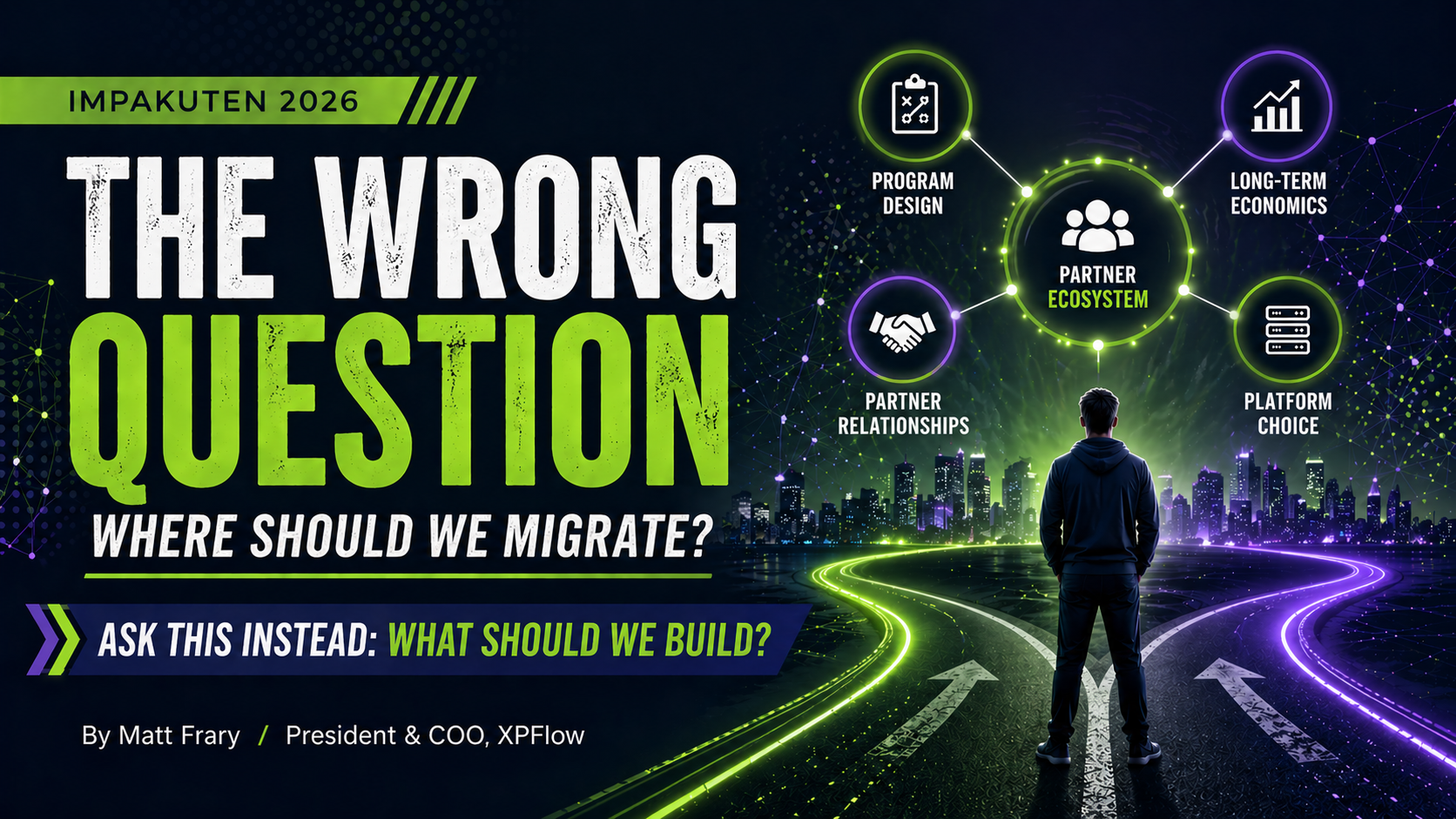
The Impakuten question I keep getting this week is the wrong one.
Every brand-side leader in my DMs is asking some version of “where should we migrate to, and how fast?” That is the question every certified agency in the field is rushing to answer for them. It is the question that sells engagements, fills calendars, and makes a busy spring feel like a productive one. And it is the wrong question.
| A better question, the one I would want my CMO asking me if I were on the brand side, is this: what kind of partner program does my business actually need in 2026, and is the answer a single platform at all? |
If you are new to the term, Impakuten is the shorthand emerging for the strategic alliance Rakuten and impact.com announced on April 28, the one that consolidates the entire Rakuten Advertising Network onto Impact’s tech stack. Per FMTC’s count, that is more than 1,800 brands. Per Rakuten’s own statements, more than 1,000 premier advertisers. Either way, it is the largest forced re-platforming event the affiliate industry has seen in a decade. There is no published deadline, which means every brand on that list now has to think, in a window of their own choosing, about where their program lives next.
I have spent twenty-seven years in this business. Chief of Chaos was the first affiliate agency ever onboarded to the Impact platform. We hold a Gold Certification today, the same one every other top agency is leading with. None of which is the point. I mention it because the perspective I am offering here is operational, not theoretical, earned by running programs at scale on Impact, on Rakuten, on CJ, on Awin, and elsewhere, and I want you to weigh it accordingly.
The reason “where do I migrate” is the wrong opening question is because it skips four others that are actually load-bearing. Let me lay them out, because these are the ones I would want a brand asking before they pick a destination.
One. What is the real, fully-loaded cost of each destination over a three-year horizon?
Not the sticker price. The incremental growth fees, the platform minimums, the contract rigidity if your program contracts, the cost of services bundled in or excluded. Most brands are being shown a one-page proposal. Ask for the model. If your account team cannot produce a three-year P&L view of your program economics on each candidate platform, that itself is information.
Two. What happens to your existing partner relationships when you move?
A migration is not a software deployment. It is a thousand re-onboardings of partners who now have to re-paper, re-verify, re-test their links, and in some cases re-trust you. The brands that lose the least in a transition are the ones that treat partner continuity as a first-class problem. Ask each candidate platform what their tooling looks like for partner data export, contract re-papering, and tracking continuity through cutover. The answers will surprise you.
Three. Is your current program design even what your business needs in 2026?
Most of the brands on Rakuten built last-click coupon-and-cashback programs because Rakuten’s network rewarded that mix. The forced migration is, if you let it be, a forcing function to ask whether that is the program design that matches your brand, your margins, and your audience today. Maybe the answer is yes. Maybe it is a hybrid: an SMB-friendly platform plus a creator layer plus first-party referral, orchestrated as one program. Maybe it is something you have not pictured yet. Do not waste a re-platform by putting the same program on a new rail.
Four. Who is giving you the advice, and what is their incentive?
If your advisor is certified on one platform and only one platform, they will recommend that platform. They have to. It is their entire credential. There is nothing wrong with that, but you should know it. Ask whoever is advising you which platforms they have operational experience on and how recently. Not certifications, operations. The answers will narrow the room considerably.
THE STRUCTURAL READ
Step back from the four questions and you can see the structure. Every certified agency in the industry is rushing to Impakuten with picks and shovels: billable hours, cert-stamped migration packages, “we will move you to Impact” SOWs. Almost no one is doing the harder work of mapping where the gold actually is, which is in the program design, the partner ecosystem, and the long-term economics of the choice, not in the labor of moving you. Brands need cartographers more than they need pickaxes right now. The cartographer’s job is to tell you where the deposit actually sits before you start digging.
That work does not end at the brand level, by the way. Affiliate partners (publishers, content sites, creators, cashback operators) are the constituency nobody is writing for in this moment, and they are the ones absorbing the most friction. Hundreds of thousands of partner-side re-onboardings are about to happen across these 1,800 programs, with broken tracking and dropped relationships scattered through the transition. We will be paying close attention to that side of the ecosystem in the coming weeks, because the partners who get advised badly are the ones every brand will lose money on. More on that in a follow-up piece.
WHAT WE ARE DOING ABOUT IT
Alfie, our Partner Operating System, is getting a new capability we are calling Bridge: built to automate the operational lift of any platform migration, regardless of destination. Partner data export and re-import. Contract re-papering. Tracking continuity. Program rebuild against the destination platform’s schema. Bridge enters closed beta with a small cohort of lighthouse brands in May and goes public-beta before iPX in June. It is the antidote to the billable-hours model that the rest of the field is selling.
We are also standing up an Advisory Council focused on the bigger question, the one this moment forces every CMO to ask: what role does partnership actually play in a modern growth stack? More on that soon. The point of the Council is the point of this piece: the conversation has to be larger than “which rail do I switch to.”
WHERE TO START
If you are a brand on the Rakuten list and you want a real, useful read on your situation before you pick a destination, the front door is the Impakuten Audit. Ten business days. Flat fee. You walk away with a three-year cost model on each viable destination, a partner-impact assessment, a recommended program design, and a migration plan. We will tell you what we would tell our own clients. If the right answer is Impact, we will say so. If it is EverFlow, Awin, CJ, or Partnerize, we will say that too. The audit is not a sales engagement; it is the ten business days you give yourself before committing to a multi-year decision.
| BOOK THE IMPAKUTEN AUDITSchedule a free consultation with Dustin Howes, VP of Business Development. |
A CLOSING THOUGHT
The industry is in one of those rare moments where the structure itself is changing. The Impakuten alliance is the catalyst, but the structural reality is that affiliate is consolidating into two or three mega-platforms and a long tail of independents, and in that world, value moves away from platform allegiance and toward orchestration of the entire partnership economy. The companies that win the next decade in this space will not be the ones that bet best on a single rail. They will be the ones that connect brands, partners, and platforms across the rails, with infrastructure that does not care which one a given program runs on.
Pick the destination thoughtfully. But do not get so caught up in the migration that you miss the bigger move.
Matt Frary is President & COO of XPFlow and Founder of Chief of Chaos, the first affiliate agency ever onboarded to the Impact platform. Reach him at matt@chiefofchaos.com.