
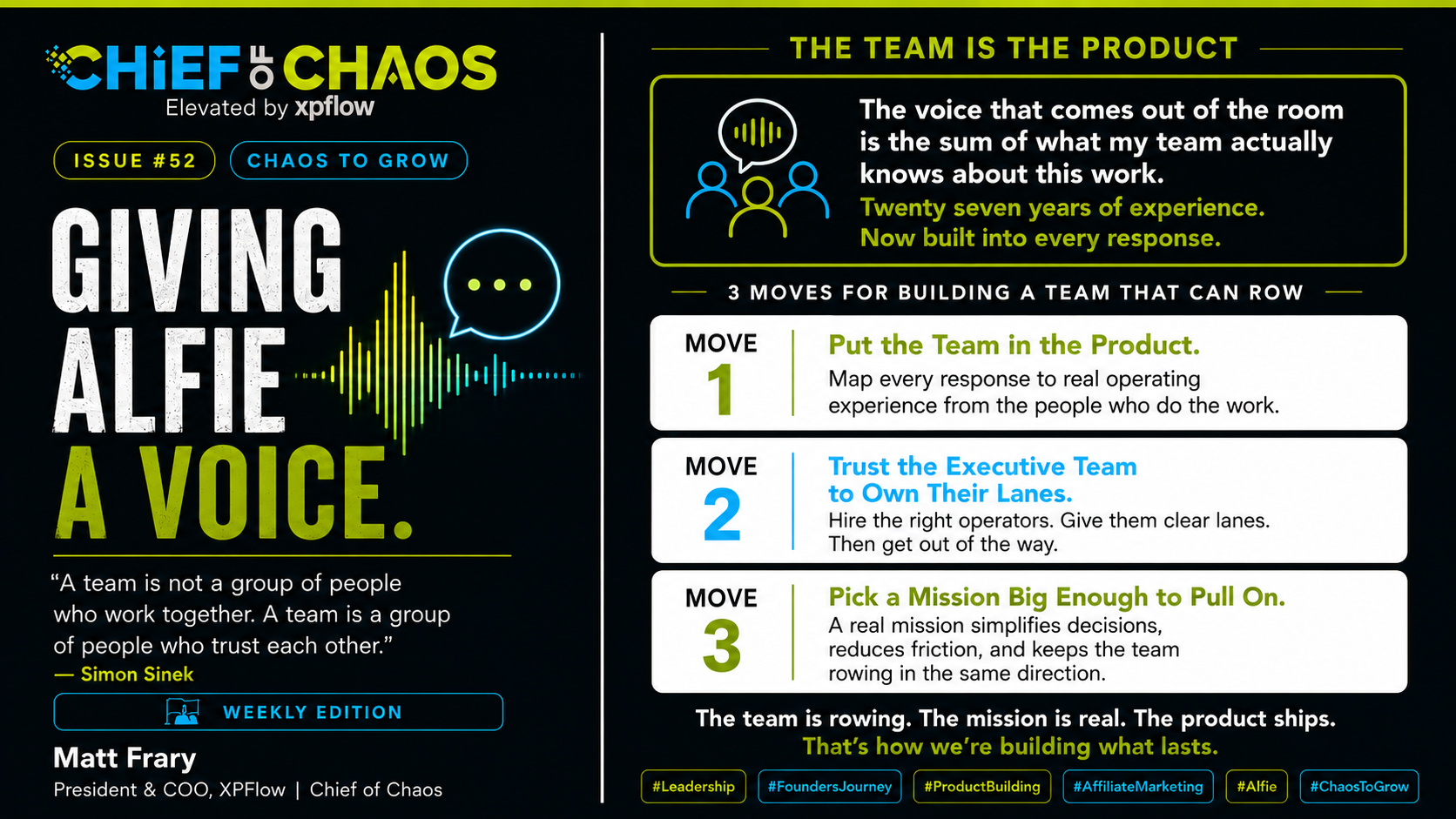
“A team is not a group of people who work together. A team is a group of people who trust each other.” Simon Sinek
This week I sat with my leadership team and we gave Alfie a voice.
Not a brand voice. Not a tone of voice guide. A real one. The kind of voice that comes from twenty seven years of doing the actual work, distilled into how a product responds when an affiliate manager asks it for help.
What does Alfie sound like when an agency lead asks him to find ten new partners in the home goods category? When an ecommerce manager asks him to draft a recruitment note that will not get ignored? When a lead gen operator asks him whether a partner is worth chasing? When the next release ships and Alfie starts going back and forth with affiliates, negotiating real commercial terms that produce real incremental revenue?
The answer cannot come out of a brand book. It has to come out of the people in the room. And the people in the room, between them, have managed more partner relationships than most platforms have ever processed.
So this week we put the team in the product.
What You’ll Get in This Issue
A reflection on what it actually takes to build a company that ships software with a voice. Three moves for building a team that can carry a product through migration, integration, and a category rewrite without coming apart. And the reason I am calmer about the next six months than I have been in years.
Part One: The Long List
I was making the list this week, mentally, of everything we are running at the same time.
Building product. Shipping product. Building a data lake. Standing up an internal marketing function. Building a sales motion that did not exist 2 months ago. Building a brand. Integrating two companies into one. Surviving a category re-platforming on top of all of it.
That is a list that breaks most early stage teams.
I did not write it down to feel impressive. I wrote it down because every one of those workstreams has a name attached to it, and every one of those names is doing the work without me checking on them every morning. That is the number that actually matters.
Most founders I have watched fail in this category did not fail because of the market. They failed because the team could not carry the load. Three things broke ten times out of ten. Trust between the executives. Clarity on the mission. And the willingness to let other people own the parts of the company they are better at than the founder is.
I have all three this time. I have not always had all three. The difference is the difference.
This is not me waving pom poms. This is me reporting a number.
The team is rowing.
Part Two: The Playbook
Three moves for getting a team to row. None of them are clever. The clever ones do not work. These do.
Move 1: Put the Team in the Product.
If you are building software for a category your team came out of, the product cannot sound like the brand book. It has to sound like the team.
This week we did the actual work of mapping every Alfie response back to a person on our side. The recruitment outreach voice came out of the people on the team who have personally sent ten thousand recruitment notes. The negotiation voice came out of the people who have personally papered partner deals at three of the largest agencies in the category. The true affiliate partner sniffing voice came out of the people who have personally cleaned up partner programs that were leaking money.
The product is now a stack of our team’s actual operating experience, in a layer the customer can talk to.
That is not a brand exercise. That is product strategy.
→ The voice is the team. Build it that way.
Move 2: Trust the Executive Team to Own Their Lanes.
I am the President and COO of XPFlow. That title has a specific job inside it. The job is to put people in the right seats and then get out of their way.
The reason we can run product, data, marketing, sales, brand, and integration in parallel is that none of those workstreams report into one person trying to be good at all of them. Each one has an executive who is better at it than I am, with a clear lane, and the trust that I am not going to override them in week three because I had a bad commute (even though I only go into an office once a week).
The hardest part of running a company at this stage is the discipline of not stepping into the lane you used to own.
If you cannot stop yourself from owning every decision, the team cannot grow. If the team cannot grow, the company cannot grow. If the company cannot grow, you are the bottleneck. And the people on your team will know it before you do.
→ Hire the right operators. Then get out of the way.
Move 3: Pick a Mission Big Enough to Pull On.
The team is rowing because we agreed, in the same room, that what we are building actually matters.
We are revolutionizing affiliate recruitment. And in doing that, we are rewriting how affiliate marketing as a whole works. Not in a deck. In the product that ships next month, and the one after, and the one after.
When the mission is big enough, the small stuff becomes easier. Internal disagreements get resolved against the mission instead of against personalities. Prioritization conversations get shorter. The week’s friction gets absorbed.
When the mission is small, the smallest disagreement becomes the meeting. Most teams I have watched come apart, came apart in those meetings.
The mission has to be bigger than the day. Ours is. That is the third thing I have this time that I have not always had.
→ Mission is the thing the team rows toward. Make it real.
Your Weekly Chaos Challenge
Take an honest look at your executive team this week.
Ask three questions.
- Do they trust each other in the rooms I am not in?
- Do they own their lanes without me having to step in?
- Do they agree on what the mission actually is, in a sentence?
If the answer to any one of them is no, that is the work this quarter. Not the next feature. Not the next campaign. The team.
→ The team is the product. Fix the team first.
Final Thought
We spent this week giving Alfie a voice.
That sounds like a marketing exercise. It is not. The voice that came out of the room is the sum of what my team actually knows about this work. Twenty seven years on my side. Close to a hundred years if you stack the rest of them up.
When an affiliate manager interacts with Alfie next month, they will not be interacting with a model. They will be interacting with the operating experience of one of the most senior partnership marketing teams ever assembled into one product.
That is not the kind of company you build with a roadmap and a Slack channel. You build it with trust, with executives who own their lanes, and with a mission that is big enough to pull the whole boat in the same direction.
We have all three.
The team is rowing.
If you are running a company at the same stage and the team is not rowing yet, hit reply. I will tell you which of the three moves cost me the most to learn.
Until next week.
Run toward the chaos.
Matt Frary Chief of Chaos // President & COO, XPFlow
#Leadership #FoundersJourney #ProductBuilding #AffiliateMarketing #Alfie #ChaosToGrow