
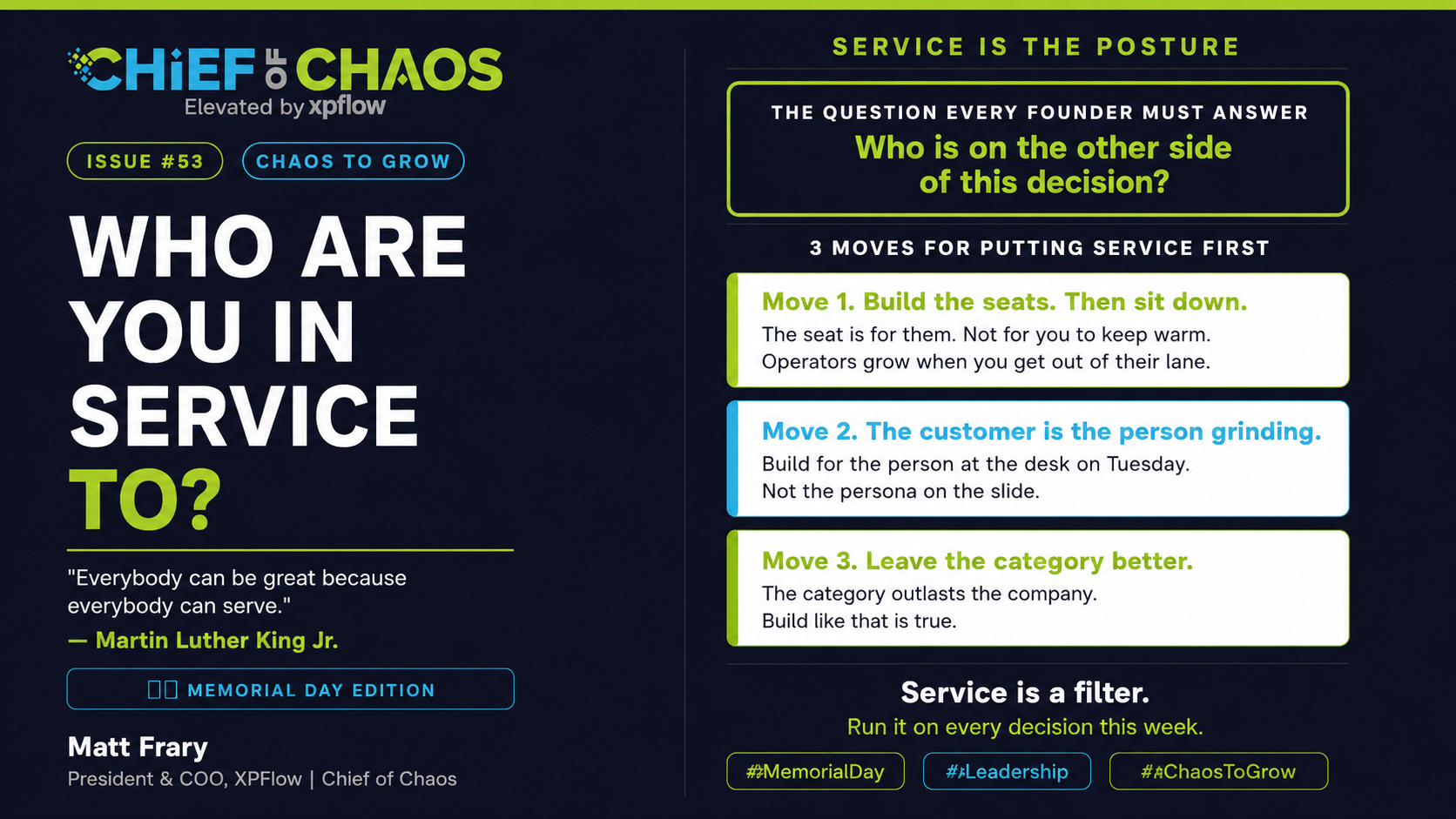
“Everybody can be great because everybody can serve.” Martin Luther King Jr.
It is Memorial Day. The work pauses for a day. I am going to use the pause for the question most founders dodge.
Who are you actually in service to?
Not on the about page. Not in the deck. In the week. When you make the calls you make, when you take the meetings you take, when you say yes to one thing and no to three others, who is on the other side of that decision?
Memorial Day exists because some people answered that question with the highest possible price. I am not going to compare anything I do in a quarter to what they did. That is not the analogy. The analogy is the posture. Service is the posture. The people we honor today were in service to something bigger than themselves, and the rest of us get to live inside the country they protected.
Founders, operators, leaders. We have a softer version of that question. And most of us answer it by accident instead of on purpose.
So today I am going to answer it on purpose. And I am going to ask you to do the same.
What You’ll Get in This Issue
A reflection on the posture I think actually separates the founders who build something durable from the ones who burn the team out chasing a feeling. Three moves for putting service back at the center of how you operate. And the reason I think the next chapter of this category will be won by the teams who get this part right.
Part One: The Question
Founders fall into one of two camps. I have been in both, so I am not pointing at anyone I have not pointed at myself.
Camp one is in service to the work. The team. The customer. The mission. The category. The thing they are trying to build that did not exist before they started.
Camp two is in service to the feeling of being a founder. The optics. The deck. The next round. The applause. The version of themselves they want to be at the dinner party.
Both camps say the same words on the website. You cannot tell them apart from the outside. The team can tell them apart from the inside in about ninety days.
The reason this matters is not philosophical. It is operational. Camp one builds companies that survive the hard quarter. Camp two builds companies that look like camp one until the hard quarter arrives, at which point the founder protects the optics instead of the team, and the team figures it out, and the company quietly comes apart in the months after.
The hard quarter is the test. The posture before the hard quarter is the prep for the test.
I am writing this on Memorial Day because today is the day to do the prep. Not in the middle of the hard quarter. In the quiet on a Monday in May, when nothing is on fire and the test is still six months out.
The question is the same one. Who are you in service to?
Part Two: The Playbook
Three moves for putting service back at the center. None of them are clever. The clever ones do not work. These do.
Move 1: Build the Seats. Then Sit Down.
The first move of a founder in service to the team is to build the seats around them and then actually sit in their own.
I wrote about this last week. The discipline of not stepping into the lane you used to own. Today I want to add the second half of it. Building the seats is not the hard part. Sitting down in your own is.
If you are a founder and you have built a real executive team, you have done the most important strategic work of the year. If you also override them in week three because a customer email rattled you, you have done none of it.
The team can feel the difference between a CEO who built the chair for them to fill and a CEO who built the chair and then keeps sitting in it themselves. The first one creates operators. The second one creates resentment.
Service to the team starts with sitting down.
→ The seat is for them. Not for you to keep warm.
Move 2: The Customer Is the Person Grinding.
If you build software for a category you came out of, the customer is not a logo. The customer is a person at a desk on a Tuesday afternoon, three tabs deep into a workflow that nobody at the executive level ever has to see.
For us at Alfie, that person is the affiliate manager. The one staring at a partner list at 4pm trying to find the next hundred recruits before the quarter ends. The one rewriting the same outreach template for the fortieth time this month. The one explaining to her CFO, again, why the partner work she did in Q1 is the reason the Q2 number is what it is.
She is not the user persona on the slide. She is the customer. And the entire question of whether the product is in service to her or in service to our cap table gets answered every time we make a roadmap decision.
Service to the customer is not a value. It is a filter. Every roadmap meeting either passes that filter or it does not.
The teams that drift are the teams that stop running the filter. The teams that compound are the teams that run it on every release.
→ The customer is a person. Build for the person, not the persona.
Move 3: Leave the Category Better Than You Found It.
This one is the long arc.
I have been in partnership marketing for twenty seven years. The category was built by people who are mostly not in the rooms anymore. Some of them have moved on. Some of them moved on a long time ago. The infrastructure they built has been getting re-platformed, re-imagined, and in some cases ripped out and replaced for a decade.
I do not owe them sentimentality. I owe them better work than they were able to do with the tools they had.
That is the third version of service. Service to the category. The thing that is bigger than my company. The thing my company is allowed to operate inside because a generation of operators built it before any of us called it the partnership economy.
When you run the next chapter of any category, you have two options. You can extract from it. Or you can leave it stronger than you found it. The first one is faster. The second one is the one that gets your name attached to the chapter in retrospect.
I would rather get the chapter than the quarter.
→ The category outlasts the company. Build like that is true.
Your Weekly Chaos Challenge
This week, before the next meeting that matters, ask yourself the question.
Who is on the other side of this decision?
Not the abstraction. The actual person. The teammate whose lane I am about to step into. The customer whose Tuesday I am about to make harder. The peer in the category who is trying to do the same work I am.
If the answer is none of them, and the only person on the other side of the decision is me, that is the decision to look at twice.
→ Service is a filter. Run it on every decision this week.
Final Thought
I am taking the day. The team is taking the day. The work that matters most this week is not the work that gets done on Monday.
But the question is the one I am going to carry into Tuesday morning.
Who am I in service to?
I have an answer this year that I have not always had. The team I am building. The customer who is grinding at a desk on a Tuesday afternoon. The category that is going to outlast all of us, if we treat it right.
That is the posture. That is the prep for the hard quarter, whenever it shows up.
To the people we honor today, and to the families they left behind, thank you. We get to build because you served.
The rest of us, in our much smaller way, get to ask the same question. And answer it on purpose.
If you have an answer of your own, hit reply. I read every one.
Until next week.
Run toward the chaos.
Matt Frary
Chief of Chaos
President & COO, XPFlow
#MemorialDay #Leadership #FoundersJourney #PartnershipEconomy #Alfie #ChaosToGrow