
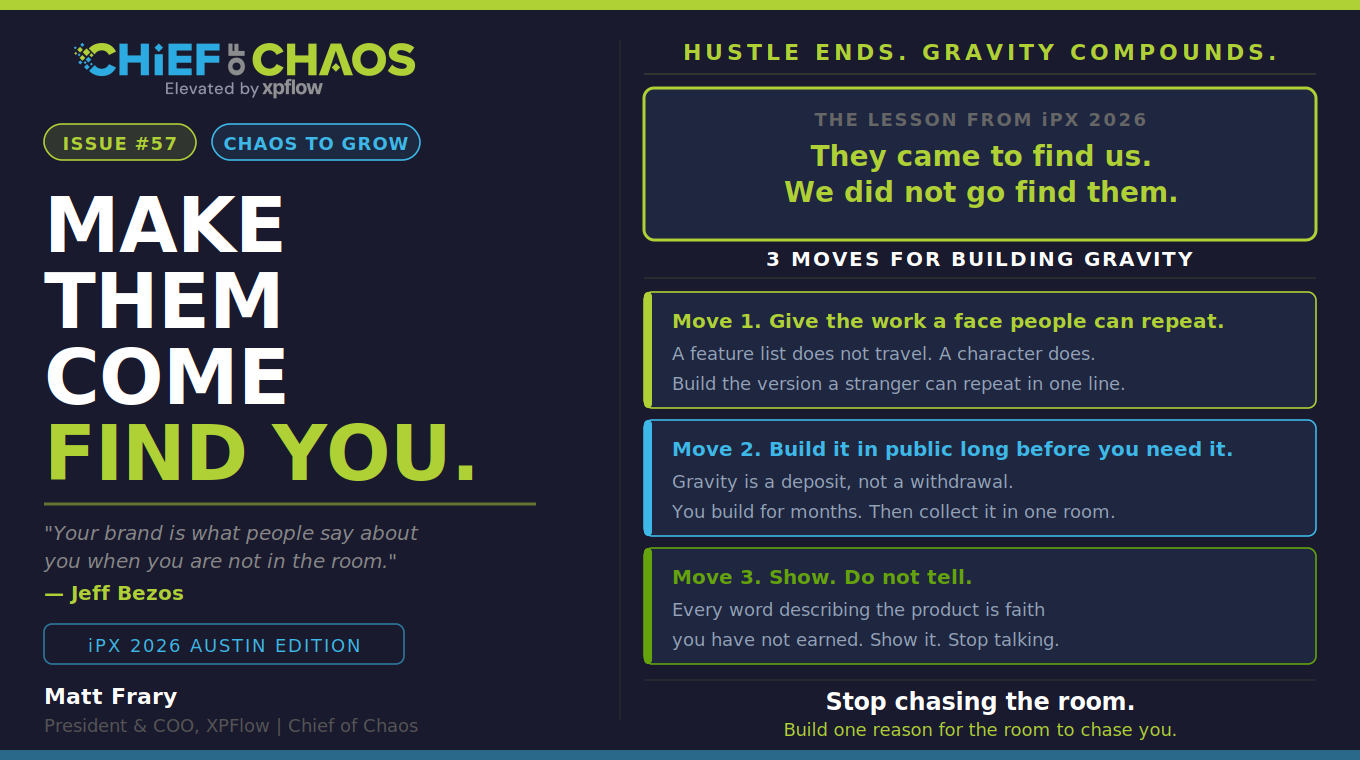
“Your brand is what other people say about you when you are not in the room.” — Jeff Bezos
I went to the biggest room in our industry at iPX 2026 in Austin this year with a plan and a number.
The number was twenty. Twenty qualified conversations, decision makers only, every one logged before I left the floor. The plan around it was the one every founder runs at a conference. Build the target list. Pre book the meetings that matter. Walk in with a printed sheet of faces and titles so you can spot the right people in a crowd and go get them. It is a hunting trip, and I packed for the hunt.
I came home having learned that I had the arrow pointing the wrong way.
The best thing that happened all week was not a meeting I booked. It was the meetings I did not. The founders, operators, and platform leaders I would have chased down a hallway to get fifteen minutes with came and found me instead. All week. They did not come for me. They came for Alfie. And that one reversal, them coming to us instead of us going to them, taught me more about how this business actually grows than any deal on the board.
This issue is about that reversal, and how to build it on purpose.
What You’ll Get in This Issue
Why the conference playbook everyone runs is built on the weaker of the two signals, and the stronger one almost nobody engineers for. Three moves for building the kind of gravity that makes the market come to you instead of the other way around. And the reason gravity beats hustle every single time, which has nothing to do with working less and everything to do with what keeps working after you go home.
Part One: The Plan Had the Arrow Backwards
There are two ways to fill a room with the right people. You can go get them, or you can become the thing they go get.
The whole conference playbook is built on the first one. Push. You hunt. You pitch. You catch someone between sessions and earn ninety seconds to say the thing you flew across the country to say. And it works, sort of. Push is real, push fills a pipeline, and I will run the push playbook again at the next one. But push has a ceiling, and the ceiling is you. It ends the moment you stop. The hustle is only ever as big as your own two feet and the hours in the day.
Then there is the other signal, and it is the one that actually tells you something. The best signal at any conference, in any market, on any given Tuesday, is when people come and find you. Not because you cornered them. Because they heard something, somewhere, when you were not in the room, and they decided on their own that they needed to talk to you.
That is what happened all week, and we did not engineer it on the floor. We engineered it months earlier. We had given Alfie a face. A personality, his own page, his own voice, put out into the world long before anyone bought anything. People at the conference told us, unprompted, that they thought it was great that Alfie had his own page and his own personality. They were not describing a feature. They were telling me that the work had developed its own gravity. It had become a thing people talked about when we were not standing there, and then went looking for when they arrived.
Push is you reaching. Gravity is them arriving. One of those scales with your effort. The other scales without you. Here is how you build the second one.
Part Two: The Playbook
Three moves for building gravity instead of chasing it. None of them happen at the event. That is the whole point.
Move 1: Give the Work a Face People Can Repeat.
People do not pass along a feature list. They pass along a character.
We did not make Alfie a personality because it was cute. We did it because a thing with a face is a thing people can mention to each other when we are not in the room, and that mention is the entire engine. Bezos had it exactly right. Your brand is what people say about you when you are not there. A spec sheet does not survive that conversation. A character does. “You have to see this thing Alfie does” travels in a way that “they have an affiliate matching tool” never will.
That is not marketing paint on top of the product. It is a decision about whether the work is repeatable in a sentence by someone who does not work for you. If a stranger cannot describe what you do to another stranger in one excited line, you do not have gravity yet. You have a brochure.
→ A feature list does not travel. A character does. Build the version of your work a stranger can repeat in one line.
Move 2: Build It in Public Long Before You Need It.
The conference did not create the gravity. It cashed a check we had been writing for months.
This is the part founders skip, because it does not pay off on the day you do it. Every post, every glimpse of Alfie out in the world, every time we let people watch the thing take shape, none of it converted anything that afternoon. It compounded quietly until the week it all showed up at once, in a room, in the form of people walking up to us already knowing who we were. You cannot manufacture that the week of the event. There is no booth big enough and no hustle fast enough to fake months of showing up.
So the work is boring and it is early. You put the thing into the world before it is finished, before there is anything to buy, before it is even clearly working, and you keep doing it when nobody is clapping. Then one day the room is full of people who feel like they already know you. That is not luck. That is a deposit you made a long time ago, finally clearing.
→ Gravity is a deposit, not a withdrawal. You build it in public for months, then collect it all in one room.
Move 3: Show, Do Not Tell.
Here is the most consistent thing I saw all week. The moment you stop describing the product and actually show it, the conversation changes in a single second. The line I kept coming back to is simple. The moment you show Alfie to somebody, they say oh, now I get it. It is visual.
Telling is you asking someone to imagine the value. Showing is you handing it to them. Every word you spend describing what the thing would do is a word spent asking for faith you have not earned yet. The fastest believer is the one who watched it work with their own eyes. We learned this so clearly at the conference that we are now teaching everyone on the team to demo, because the demo is not a sales step, it is the moment the gravity actually grabs.
If you find yourself explaining your product more than showing it, that is a tell. It usually means the thing is not yet simple enough to show, and that is the real problem to go fix. Make it showable. Then show it, and stop talking.
→ Every word describing the product is faith you have not earned. Show the thing working and let the room get it for themselves.
Part Three: What Gravity Actually Buys You
Here is the payoff that surprised me most, and it is the reason this is worth engineering instead of leaving to chance.
When you are pushing, the other person is on defense. They know you want something, so they guard the truth. But when they came to find me, the whole dynamic flipped. They were not a prospect I was convincing. They were relaxed, curious, and honest. And in that mode, one of the biggest players in our entire space told me, completely unprompted, exactly what they would pay us for. Not what I hoped they wanted. What they actually wanted, said out loud, while I was doing nothing but listening. That is a piece of strategy you cannot buy and cannot pry loose when you are in sell mode. Gravity hands it to you for free.
There was a second piece, and it is quieter. At one point I had to decide whether to name an awkward thing out loud in a room full of competitors, something that had happened between us and a much larger player, the kind of thing most people leave politely unspoken. I named it directly. Not as an attack, just as the true thing nobody was saying. And instead of blowing up, it built trust. Afterward the person it concerned sought me out and admitted they had braced for exactly that, and respected that I said it. Candor is its own form of gravity. People come find the person who is willing to say the true thing in the room.
→ When people come to you, they stop guarding the truth. Gravity does not just bring the room. It tells you what the room actually wants.
Your Weekly Chaos Challenge
Look at the thing you are pushing hardest right now. The deal, the product, the pitch you keep having to chase.
Ask one question. What would make them come find me instead? Then do exactly one thing this week that builds gravity rather than spends effort. Give the work a face someone could repeat. Put it out in public before it is ready. Or take the thing you keep describing and get it in front of one person by showing it instead of explaining it.
You will not feel the payoff this week. That is the nature of gravity. You are making a deposit. But you will have started building the one kind of pull that keeps working after you have gone home and stopped pushing.
→ Stop chasing the room. This week, build one reason for the room to chase you.
Final Thought
I used to measure a conference by how hard I worked it. Meetings booked, hands shaken, hours on my feet. By that scoreboard I would have called this one a success and missed the actual lesson entirely.
The lesson was not in anything I pushed. It was in everything that came back to me without a push, and the realization that all of it traced back to quiet, unglamorous work we did months before anyone was watching. We gave the work a face. We put it out in the world early and kept showing up. We let people see it work instead of hearing about it. None of that happened at the event. The event was just where the bill came due, in our favor.
Hustle is real and I am not telling you to stop. But hustle ends when you stop, and gravity keeps working while you sleep. One of those is a job. The other is an asset. The founders who pull away are not the ones who pushed hardest in the room. They are the ones who spent the months before it building reasons for the room to come to them.
So go work the floor. Book the meetings. Run the push. But spend the quiet weeks building the thing that makes the arrow point back at you, because that is the half of the game almost nobody plays on purpose, and it is the half that compounds.
If you have ever had someone come find you because of work you did long before you met them, hit reply and tell me what it was. I read every one.
Until next week.
Run toward the chaos.
Matt Frary